

It often begins as a quick solution—a parent needs a few uninterrupted minutes, a child is restless, and a screen fills the gap. At first, it feels harmless. But over time, those short moments can turn into a daily pattern that’s harder to adjust than expected. For families with toddlers and preschoolers, managing screen time isn’t just about limiting use—it’s about understanding how those habits shape behavior, sleep, attention, and early learning.
Parents today are navigating something previous generations didn’t face at this scale. Screens are everywhere—at home, in public spaces, even built into learning environments. So the question isn’t whether children will use them, but how to approach managing screen time in a way that actually supports development rather than competing with it. This guide takes a closer look at what matters most, where families tend to get stuck, and how to create screen habits that feel realistic, balanced, and sustainable.
Why Screen Time Matters More in Early Childhood
During the toddler and preschool years, the brain is developing at a remarkable pace. This is when children learn language, emotional regulation, problem-solving, and social cues—primarily through real-world interaction.
Screens, by their nature, change how children experience these moments.
A well-designed educational program can support learning in small doses. But passive or excessive screen use can displace the very experiences young children need most:
- Face-to-face conversation
- Physical play and movement
- Hands-on exploration
- Unstructured imagination
This is usually overlooked, but it matters: it’s not just about what children are watching—it’s what they’re not doing while they’re watching.
Recommended Screen Time Guidelines (And How to Interpret Them)
Most early childhood experts suggest:
- Under 18 months: Avoid screens, except for video calls
- 18–24 months: Limited, high-quality content with adult involvement
- 2–5 years: Around 1 hour per day of high-quality programming
That said, families often struggle with rigid limits. Real life isn’t always that predictable.
Here’s where nuance comes in. A child who watches 45 minutes of a slow-paced, educational show with a parent is having a very different experience than one who spends an hour scrolling fast-paced videos alone.
Instead of focusing only on time, experienced caregivers tend to evaluate three factors:
1. Content Quality
Is it age-appropriate, slow-paced, and designed for learning?
2. Context
Is an adult present to talk about what’s happening?
3. Consistency
Is screen time predictable, or does it happen randomly throughout the day?
When these are in place, screen use becomes more manageable and less disruptive.

Common Mistakes Families Make (And Why They Happen)
Even well-intentioned parents fall into patterns that make screen time harder to control.
Using Screens as the Default Soothing Tool
It works quickly. A tantrum stops, a child calms down. But over time, children begin to rely on screens instead of developing self-regulation skills.
Lack of Clear Boundaries
When screen time happens “whenever,” children push for more—and parents end up negotiating constantly.
Background Screens
Television running in the background may seem harmless, but it reduces the quality of play and parent-child interaction.
Choosing Convenience Over Content
Fast, flashy videos often hold attention better—but they can overstimulate young children and shorten attention spans.
Here’s where things often go wrong: families focus on reducing conflict in the moment instead of building long-term habits. The short-term fix becomes the long-term problem.
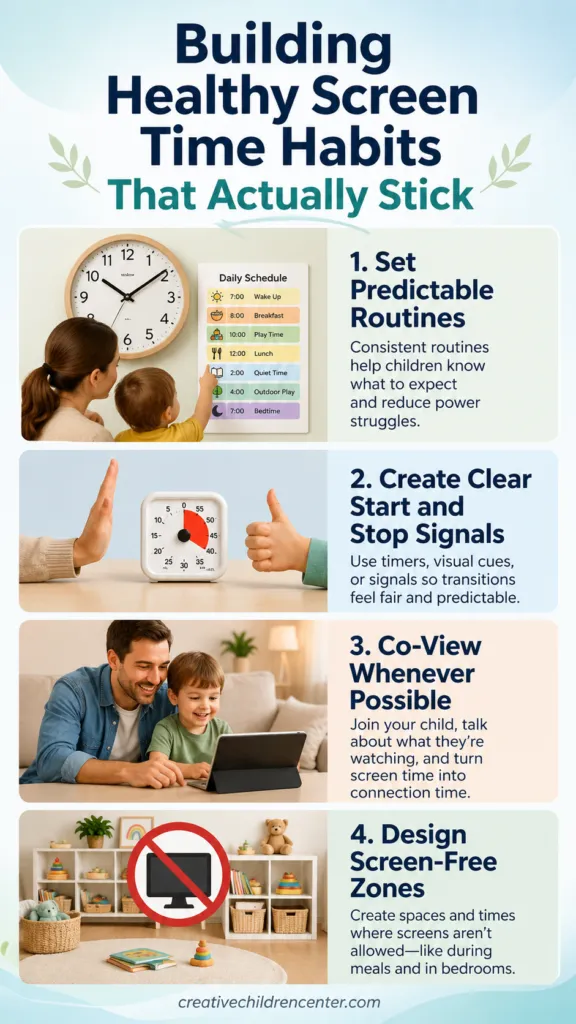
Building Healthy Screen Time Habits That Actually Stick
Building healthy screen time habits that last comes down to managing screen time with consistency and purpose—not rigid control or unrealistic limits.
1. Set Predictable Routines
Children do best when they know what to expect.
Instead of saying “maybe later,” tie screen time to a consistent part of the day:
- After nap time
- While preparing dinner
- As part of a wind-down routine (not right before bed)
When screen time is predictable, children ask for it less often.
2. Create Clear Start and Stop Signals
When managing screen time, young children often struggle with transitions, especially when screens are involved, which makes clear start and stop signals essential for building predictable routines.
- Giving a 5-minute warning before turning off the device
- Using visual timers
- Ending at a natural break in the content
Abruptly turning off a device often leads to meltdowns—not because the child is misbehaving, but because their brain isn’t ready to shift yet.
3. Co-View Whenever Possible
Watching with a child changes the experience entirely.
Instead of passive viewing, it becomes interactive:
- Asking questions (“What do you think will happen next?”)
- Naming emotions (“That character looks frustrated”)
- Connecting to real life (“Remember when we saw something like that?”)
This helps children process what they’re seeing and builds language skills at the same time.
4. Design Screen-Free Zones
Some boundaries are easier to maintain when they’re tied to physical spaces:
- No screens during meals
- No devices in bedrooms
- Limited use during family time
This reduces constant negotiation and protects important routines.
Choosing the Right Content for Toddlers and Preschoolers
When managing screen time, it’s important to recognize that not all content is equal—some supports development, while other content works against it.
1. What to Look For
- Slower pacing
- Simple storylines
- Repetition (which supports learning)
- Clear language and narration
- Positive social interactions
2. What to Limit
- Rapid scene changes
- Loud, overstimulating visuals
- Content designed for older children
- Algorithm-driven video feeds
It depends on the child, but in general, simpler is better for younger ages.
This is usually overlooked, but it matters: children don’t need constant novelty. In fact, repetition helps them understand and retain information.
Managing Screen Time Without Constant Conflict
One of the biggest challenges in managing screen time is resistance—children wanting “just one more video.”
This is less about defiance and more about development. Young children don’t yet have the skills to stop something they enjoy.
Here’s what tends to work in real-world settings:
1. Offer Alternatives Before Saying “No”
Instead of removing the screen abruptly, redirect:
- “Let’s build something together”
- “Do you want to go outside or draw?”
This reduces the sense of loss.
2. Keep Devices Out of Immediate Reach
If a device is always visible, it becomes a constant source of negotiation.
Out of sight doesn’t eliminate requests entirely—but it reduces frequency.
3. Stay Consistent (Even When It’s Hard)
Children test limits. That’s normal.
If boundaries change daily, children push harder. When limits are consistent, resistance usually decreases over time.
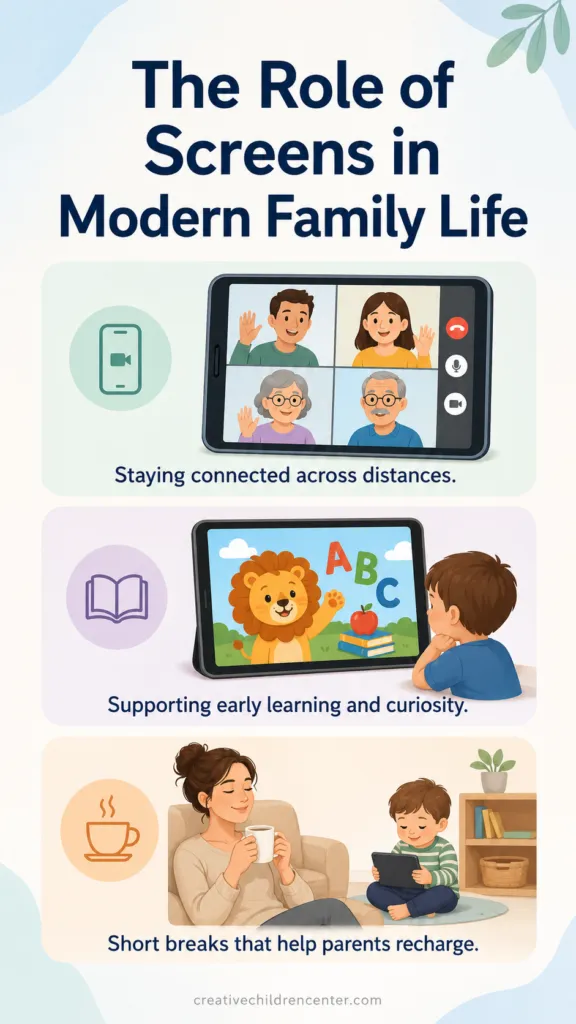
The Role of Screens in Modern Family Life
It would be unrealistic—and unnecessary—to eliminate screens entirely.
Screens can be helpful:
- Video calls with family members
- Educational programs
- Occasional downtime for parents
The goal isn’t perfection. It’s balance.
Experienced caregivers understand that screen time is a tool. Like any tool, its impact depends on how it’s used.
Myth vs Reality: What Families Often Get Wrong
When it comes to managing screen time, many families are guided by assumptions that feel true in the moment but don’t always reflect how children actually develop or respond to screens.
Myth: “All screen time is harmful”
This oversimplification creates unnecessary guilt.
Reality: Quality and context matter far more than the presence of screens alone. A short, interactive viewing experience can be beneficial.
Myth: “Educational apps guarantee learning”
The label “educational” is often misleading.
Reality: Young children learn best through interaction, not passive tapping or watching. Apps can support learning—but they don’t replace real-world experiences.
Myth: “More screen time means better tech skills”
Parents sometimes justify screen use as preparation for the future.
Reality: At this age, foundational skills—language, attention, problem-solving—are far more important than digital proficiency.
Myth: “If the child is quiet, the screen is helping”
A quiet child can feel like a win, especially on a busy day.
Reality: Silence doesn’t always mean engagement or learning. Sometimes it simply means the child is overstimulated or absorbed without processing.
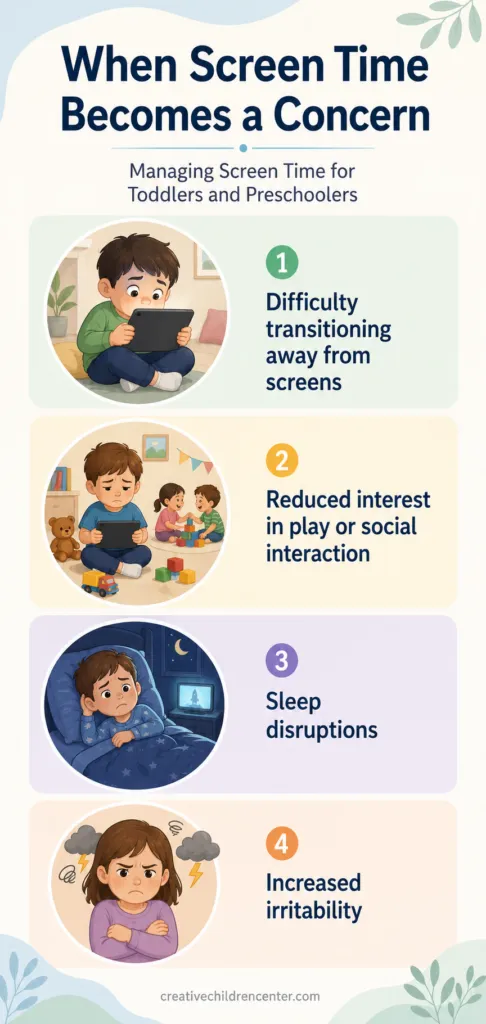
When Screen Time Becomes a Concern
There are moments when screen use may need closer attention.
Signs to watch for:
- Difficulty transitioning away from screens
- Reduced interest in play or social interaction
- Sleep disruptions
- Increased irritability
These don’t automatically mean something is wrong—but they signal a need to reassess habits.
Sometimes, small adjustments—like reducing duration or changing content—can make a noticeable difference.
Practical Daily Framework for Families
For many families, a simple structure works better than strict rules.
Here’s a realistic approach:
- Prioritize essentials first
- Sleep
- Meals
- Outdoor play
- Social interaction
- Add screen time intentionally
- Choose a specific time of day
- Limit to a set duration
- Stay flexible when needed
- Travel days
- Illness
- Unusual schedules
This balance allows families to maintain consistency without feeling rigid.
Supporting Children Beyond the Screen
Reducing screen time is only part of the equation. What replaces it matters just as much.
Young children benefit from:
- Open-ended toys
- Sensory play (water, sand, clay)
- Outdoor exploration
- Music and movement
- Simple household tasks
This is where development really happens.
Interestingly, when children are engaged in meaningful play, screen time becomes less of a focus—both for them and for their parents.
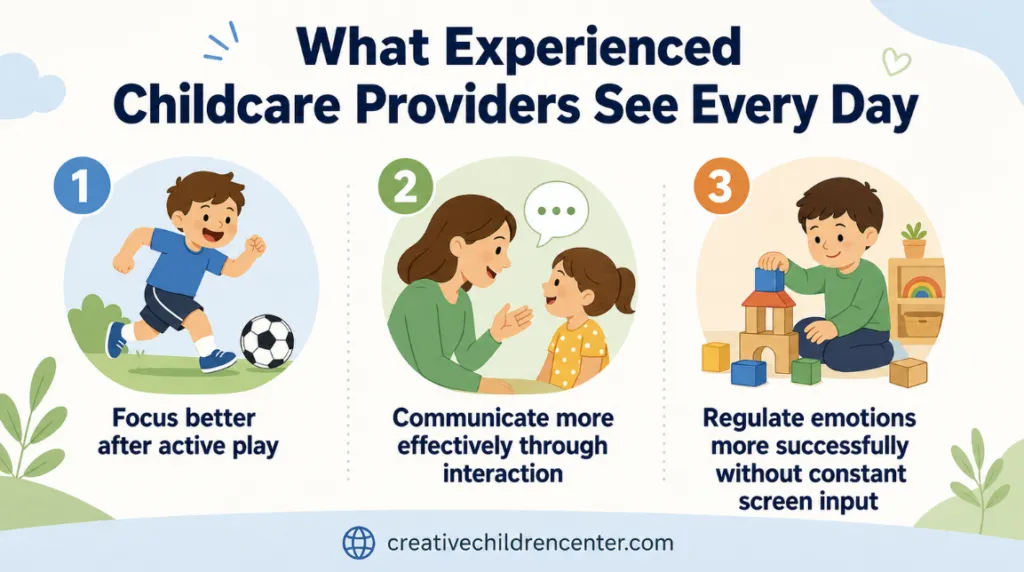
What Experienced Childcare Providers See Every Day
In structured early childhood settings, screen use is often minimal or carefully controlled.
Why?
Because professionals consistently observe that children:
- Focus better after active play
- Communicate more effectively through interaction
- Regulate emotions more successfully without constant screen input
This doesn’t mean screens are harmful in all cases—but it highlights how powerful real-world experiences are during these early years.
A Thoughtful Approach That Works Long-Term
Managing screen time for toddlers and preschoolers comes down to a few core principles: be intentional, stay consistent, and focus on the bigger picture. Screens are not the enemy, but they should never replace the experiences that drive early development—play, connection, and exploration. Families who approach screen use with structure and awareness tend to see fewer conflicts and healthier habits over time.
For families looking to build these habits more effectively, environments that reinforce balanced routines can make a meaningful difference. At Creative Children Center, children are guided through structured play, social interaction, and developmentally appropriate activities that naturally reduce reliance on screens. This kind of consistent, hands-on approach helps children build the skills they need—both on and off the screen—while giving families practical support they can carry into daily life.