
If you’ve ever watched a toddler start bouncing the moment a song comes on, you’ve already seen the power of music and movement for preschoolers in action. Young children are naturally drawn to rhythm and motion, using their bodies to explore sound, express feelings, and connect with the world around them. Music and movement aren’t just fun add-ons in early childhood—they are essential tools that support how children learn, communicate, and grow.
In a world filled with screens and sedentary play, music and movement for preschoolers offer a meaningful way to re-engage the whole child. These activities help strengthen coordination, language development, emotional regulation, and social confidence through joyful, active experiences. Whether at home or in early learning settings, intentional music and movement create a balanced, engaging foundation for healthy development.
Why Music and Movement Matter in Early Childhood
Music and movement are not separate developmental domains; they intertwine in the brain. For children under five, cognitive growth is multisensory. When kids sing, tap, dance, or march, multiple systems activate at once — auditory, visual, kinesthetic, and emotional pathways synchronize. This integration builds neural connections faster than passive learning ever could.
Research from early childhood specialists consistently shows that rhythmic play supports:
- Language development. Nursery rhymes, repetitive lyrics, and melodic pronunciation enhance vocabulary and phonemic awareness.
- Motor coordination. Steady beats help refine gross motor control (jumping, spinning, marching) and fine motor timing (clapping, finger motions).
- Memory and focus. Music-based activities develop sequencing ability — an essential skill for reading and math readiness.
- Social-emotional bonding. Shared musical experiences foster empathy, cooperation, and a sense of belonging.
In experience observed across early childhood settings, the biggest developmental leaps occur not during structured instruction but in spontaneous dance sessions, clapping games, and unplanned sing-alongs. These informal interactions foster emotional safety, forming the essential foundation for genuine learning.
The Brain-Body Connection: What’s Really Happening
What most people don’t realize is that when toddlers move to music, it’s not just “cute” — it’s neurotraining. The brain’s motor cortex, auditory system, and cerebellum communicate in sync to process rhythm and coordinate motion. This synchronization strengthens what’s called sensorimotor integration, critical for self-regulation and coordination later in life.
A simple example: when children learn to walk to a beat — say, “step, step, clap” — they’re unconsciously developing early math concepts (pattern recognition and rhythm) and executive function skills (inhibiting impulses to stay on the beat). It’s a sophisticated exercise disguised as fun.
From a developmental standpoint, movement provides feedback loops. When a child hears a rhythm, moves in response, and sees how their movement changes the rhythm or group dynamic, the brain learns cause and effect, adaptability, and timing — all core elements of intelligence.
Common Mistakes Parents and Educators Make
Even well-meaning parents sometimes miss the mark with music and movement for preschoolers. Here’s where things often go wrong:
- Treating music as “background.” Music used only for quiet ambiance or entertainment doesn’t engage a child’s body or attention meaningfully. It’s better to invite them into the rhythm — singing, tapping, or dancing along.
- Over-structuring the experience. Some adults think movement sessions must follow a rigid plan. In truth, flexibility builds confidence. Allow children to improvise or interpret the music differently.
- Relying solely on digital songs or videos. Screens can’t replicate human interaction. Live singing (even if off-key) and real movement invite emotional connection — the part that drives learning.
- Ignoring repetition. Adults get bored, children don’t. Repetition is where mastery happens — it’s their way of building confidence through predictability.
Recognizing these patterns can immediately change the quality of your child’s musical experiences. A few thoughtful adjustments — like lowering the volume, joining in, and letting the activity evolve naturally — create a much deeper impact.
How to Introduce Music and Movement for Preschoolers at Home
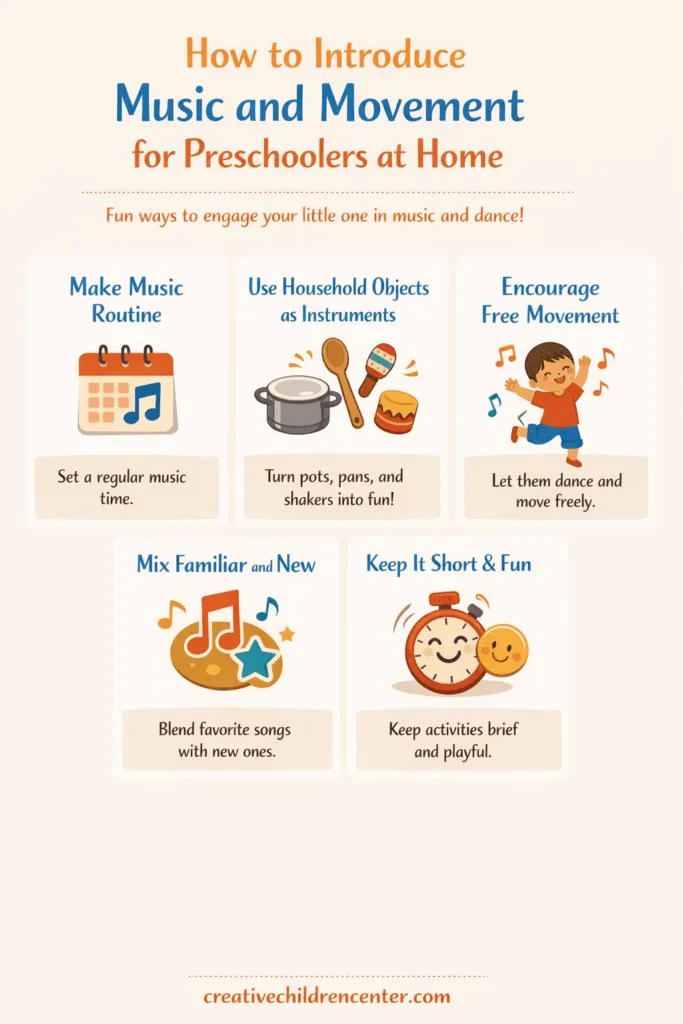
Music and movement for preschoolers sparks joy and development using everyday spaces—no fancy studio or gear required. Transform routine moments into rhythmic adventures right in your living room.
1. Make Music Routine
Integrate short music sessions into daily routines — wake-up time, bath, cleanup, or bedtime. Singing transitions (“Let’s tidy up, tidy up…”) gives structure to the day and helps children anticipate what’s next.
2. Use Household Objects as Instruments
Toddlers love cause-and-effect play. Pots, wooden spoons, rice-filled bottles — anything that makes a sound can become an instrument. What matters is rhythm, not melody.
3. Encourage Free Movement
Let children move however they feel the beat — twirling, bouncing, stomping, crawling. Resist correcting their form. In early years, freedom of motion teaches body awareness far better than imitation alone.
4. Mix Familiar and New
Balance known songs with new ones. Familiar tunes help children feel secure; new ones spark curiosity. Both feed emotional and cognitive engagement.
5. Model Participation
Children imitate enthusiastically. If you sing or dance with energy (not perfection), they will mirror that joy. Your involvement makes music feel relational, not performative.
Music for Emotional and Social Growth
Emotional regulation begins long before a child can express feelings through words. Music provides a safe and natural outlet for those emotions to surface and settle into balance.
- Calming melodies help children transition between activities, such as relaxing after energetic play.
- Upbeat rhythms release tension or boost energy during slower moments.
- Call-and-response songs foster turn-taking, empathy, and attentive listening.
For preschoolers, group music experiences — such as passing a rhythm around a circle or echoing claps — promote executive function. These activities require children to listen carefully, wait for cues, and coordinate movements with their peers, building essential pre-academic and social skills along the way.
Educators frequently observe that when children take turns serving as the “music leader,” they naturally develop confidence and leadership skills. At the same time, they learn how to follow group norms, such as starting and stopping together — demonstrating how structured musical play can nurture abilities that extend well beyond early childhood.
When and Why It Sometimes Doesn’t Work
Now, here’s the part that gets less attention — sometimes music and movement for preschoolers and toddlers routines fall flat. This usually happens when:
- Children are overstimulated or overtired.
- The music tempo doesn’t match their energy level.
- Adults expect performance instead of participation.
- There’s too much pressure to “get it right.”
When that happens, step back. Change the tempo, simplify the rhythm, or just hum quietly together. What young children need most is connection, not compliance. The goal is regulation, not perfection.
Music Across Different Developmental Stages
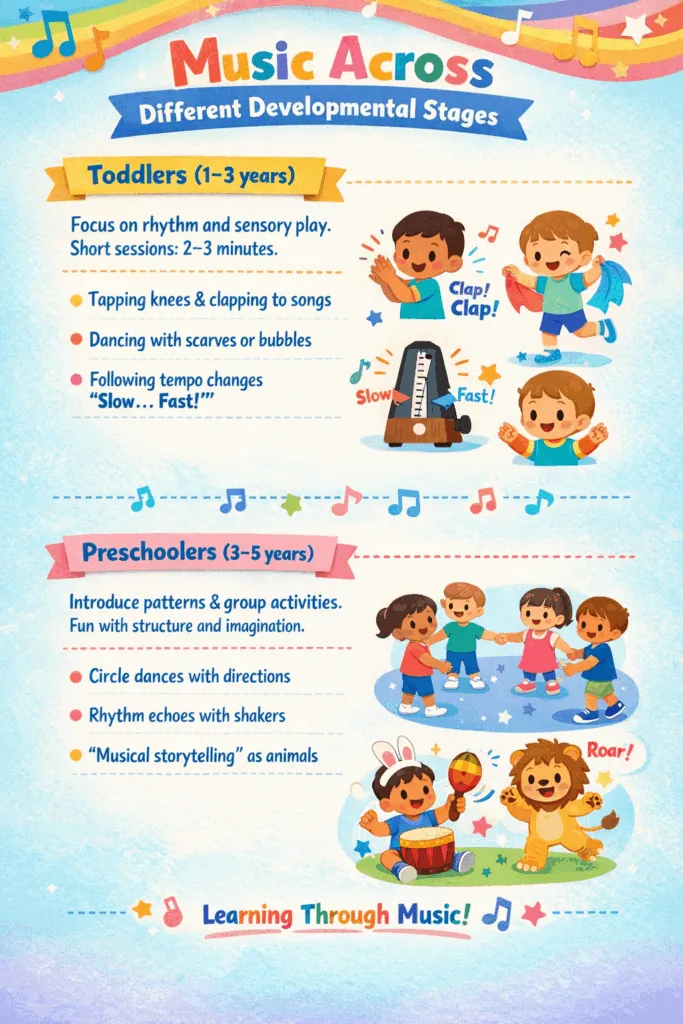
Music influences children differently as they grow, with each developmental stage offering unique opportunities for learning, self-expression, and connection through rhythm and movement.
Toddlers (1–3 years)
Focus on rhythm and sensory input. Use fingerplays, rhymes, and instruments that respond to touch. Keep sessions short — two to three minutes often suffice.
Good examples:
- Tapping knees or clapping to repetitive songs.
- Dancing with scarves or bubbles.
- Following simple tempo changes (“slow… fast!”).
Preschoolers (3–5 years)
Now you can introduce simple sequence patterns, echo singing, or group dancing. These children are ready for structure but still need freedom to explore.
Good examples:
- Circle dances that include following directions.
- Rhythm echoes using shakers or drums.
- “Musical storytelling” where movement expresses narrative (e.g., pretending to be animals).
Best Practices for Educators and Caregivers
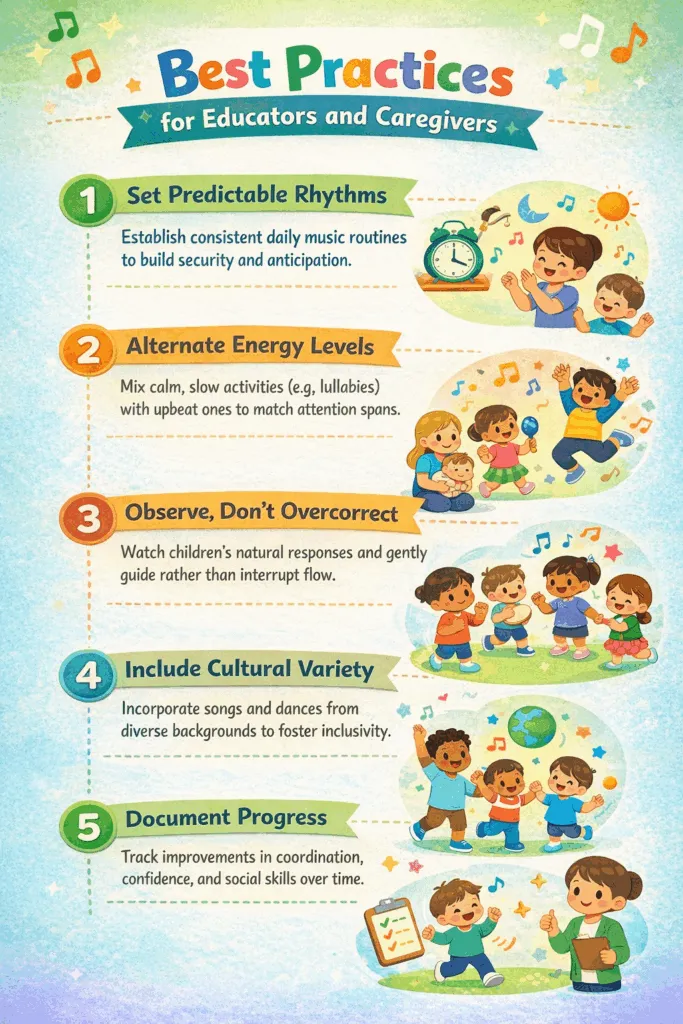
Educators and caregivers elevate music and movement for preschoolers through proven, simple strategies that build confidence and coordination in any group setting.
- Set predictable rhythms. Begin with the same song each session; consistency builds a sense of safety.
- Alternate energy levels. Follow energetic songs with calming ones — this teaches children to regulate their states.
- Observe, don’t overcorrect. Notice how each child responds. Some join immediately, others need time to watch. That passive observation can still be deeply participatory.
- Include cultural variety. Introduce songs and movements from different traditions to expand awareness and empathy early.
- Document progress. Taking short notes or videos (with permission) helps track changes in coordination and social engagement over time.
In professional early learning programs, educators often use “music circles” not just for fun, but as observational tools. They reveal which children are developing impulse control, balance, or social awareness — insights you can use to adapt teaching strategies.
Key Takeaways and Next Steps
Music and movement for preschoolers and toddlers are far more than entertaining pastimes — they are the foundation of how young children learn and make sense of the world. Through rhythm, song, and motion, toddlers and preschoolers strengthen their coordination, emotional balance, and readiness for future learning. These simple, joyful experiences nurture the whole child — body, mind, and spirit — and can be easily woven into everyday family life.
Families who want to give their little ones a strong developmental start can explore the Creative Children Center’s programs, where music and movement are used intentionally to support growth and learning. Each class is designed to blend fun with educational purpose, helping children thrive in both group and individual settings. Parents interested in fostering creativity, confidence, and connection are encouraged to discover how Creative Children Center makes early learning a joyful and enriching experience.