

If you’re raising a toddler or preschooler right now, you probably find yourself wondering things like: “Should my child already be talking this much?” or “Is it normal for them to be so shy?” Those quiet moments of uncertainty are a hallmark of parenting young children—and for good reason. Development isn’t a straight line, and understanding what “normal” looks like can be surprisingly tricky.
Child development milestones aren’t just boxes to tick off a list. They’re guideposts that help you see how your child is growing physically, emotionally, socially, and cognitively. Knowing what to look for (and when to relax) can ease a lot of that day-to-day anxiety and help you respond in ways that truly support your child’s growth.
By the end of this guide, you’ll have a clear sense of:
- What major developmental milestones look like from ages 1 to 8
- How to spot signs your child might need a little extra support
- When to be patient—and when to seek guidance
- Practical ways to nurture development through everyday play and routines
Let’s start with the one crucial principle most parents overlook.
Understanding How Children Develop
“Development Isn’t Linear — and That’s Normal”
What most people don’t realize is that kids progress in spurts. A child may suddenly master dozens of new words one month and refuse to speak much the next while focusing on physical skills instead. That’s not backsliding—it’s the brain reorganizing.
Each child grows at their own pace, influenced by genetics, temperament, environment, and daily experiences. Comparing your child to others will always be tempting, but it’s rarely helpful. Instead, think of milestones as a range, not a deadline.
The Five Core Areas of Development
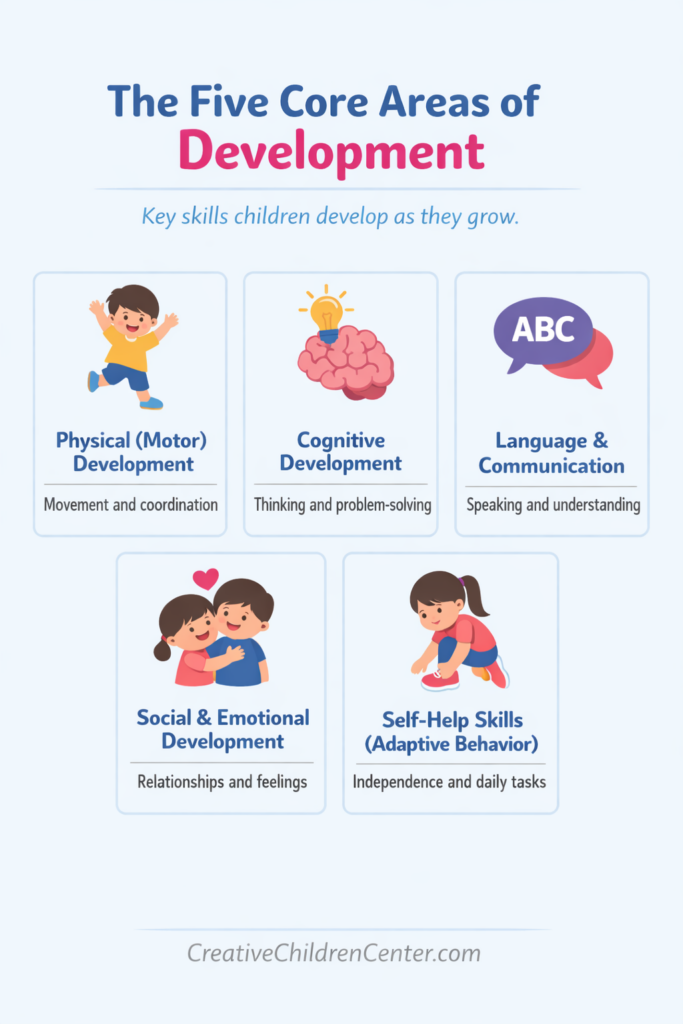
To interpret milestones wisely, it helps to know what they actually measure. Most experts group them into five broad domains:
- Physical (motor) development – Large muscle control (running, climbing) and fine motor skill (drawing, buttoning).
- Cognitive development – Thinking, problem-solving, learning concepts like time or numbers.
- Language and communication – Understanding and expressing ideas through speech or gestures.
- Social and emotional development – Managing emotions, forming relationships, empathy, independence.
- Self-help skills (adaptive behavior) – Dressing, feeding, toileting, and understanding routines.
Healthy growth means progress across all five — not perfection in any single area.
Toddler Milestones (Ages 1–3)
These are the years of discovery and chaos, when your child goes from babyhood to full-fledged personality.
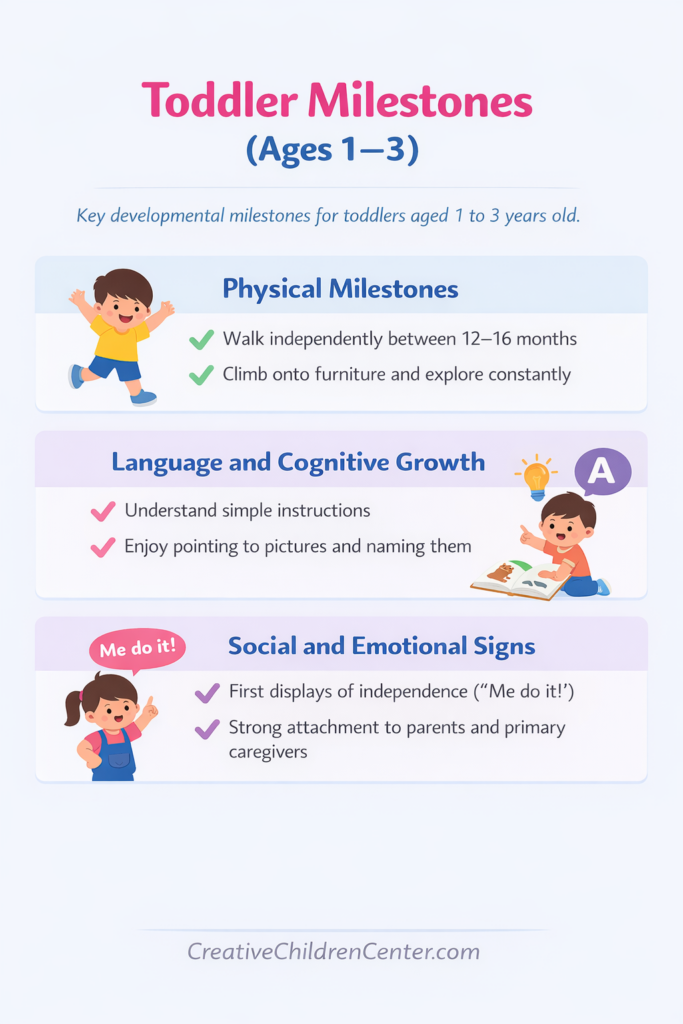
Physical Milestones
Most toddlers learn to:
- Walk independently between 12–16 months
- Climb onto furniture and explore constantly
- Stack a few blocks or feed themselves by age 2
- Run, kick, and start showing hand preference by age 3
In my experience, toddlers vary greatly here. Some are cautious walkers; others sprint before their second birthday. Unless you see persistent weakness or lack of interest in movement, variation is normal.
Language and Cognitive Growth
At this stage, toddlers:
- Understand simple instructions (“Give me the ball”)
- Use single words around one year, short phrases by two, and sentences nearing three
- Enjoy pointing to pictures and naming them
- Begin pretend play (“feeding” a doll or calling on a toy phone)
Here’s where things often go wrong: adults sometimes compare vocabulary size too rigidly. A 2.5-year-old who uses short sentences might seem “behind” compared to a talkative peer—but comprehension often matters more than total word count.
Social and Emotional Signs
Expect:
- Strong attachment to parents and primary caregivers
- First displays of independence (“Me do it!”)
- Early parallel play (playing next to, not with, peers)
- Big feelings — tantrums, joy, curiosity all mixed together
This is usually overlooked, but it matters: emotional regulation starts now. How you respond during meltdowns teaches your child more than any “lesson” ever could.
Preschooler Milestones (Ages 3–5)
Preschoolers are language sponges—curious, imaginative, and learning social norms through play.
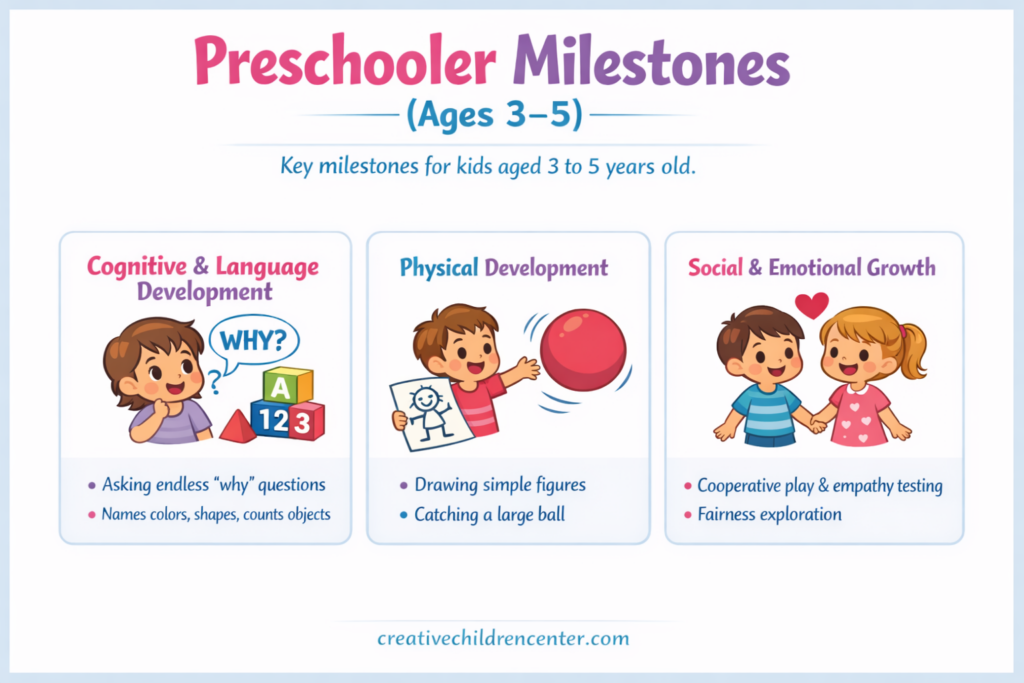
Cognitive and Language Development
Preschoolers typically:
- Speak in longer, clearer sentences understandable to strangers
- Begin asking endless “why” questions
- Can name colors, shapes, and count a few objects
- Start to understand time (“after lunch,” “tomorrow”)
At 4 or 5, they may create elaborate make-believe stories—evidence of flexible thinking. Encourage this; imaginary play builds emotional intelligence and problem-solving.
Physical Development
These years refine coordination:
- Pedaling a tricycle
- Drawing simple human figures
- Catching a large ball
- Dressing and undressing with minimal help
Fine motor skills (scissors, drawing, zippers) can vary widely. Some kids love art; others avoid it, and that’s okay.
Social and Emotional Growth
This stage brings an explosion of social learning:
- Cooperative play replaces parallel play
- Children test empathy and fairness
- Friendships start to form intentionally
- Separation anxiety fades, but social conflicts emerge
In my experience, preschoolers often display “testing” behaviors—small acts of defiance that signal identity building. Setting consistent, calm boundaries goes further than long explanations.
Kindergarten Milestones (Ages 5–6)
Now the child starts to mix imagination with logic. They want to understand the world, not just explore it.
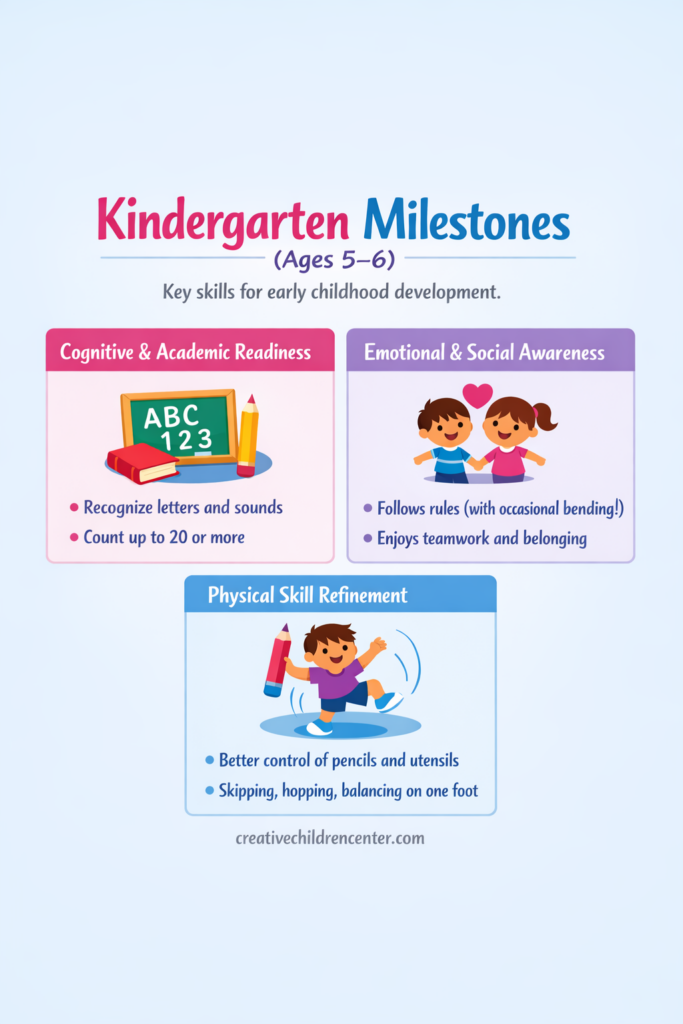
Cognitive and Academic Readiness
By kindergarten, children generally:
- Recognize letters and sounds
- Count up to 20 or more
- Begin basic writing and reading
- Understand simple rules and patterns
But here’s the catch: academic readiness depends on emotional maturity as much as intellect. A child who can sit, listen, and manage frustration often learns faster than one who only recognizes letters.
Emotional and Social Awareness
- Follows rules (with occasional bending!)
- Expresses emotions more clearly
- Starts to grasp others’ perspectives (“She’s sad because…”)
- Enjoys teamwork and belonging
What most people overlook is that emotional readiness is the foundation for school success. Children who can manage big feelings and transitions cope far better with structured learning.
Physical Skill Refinement
At this stage, balance and dexterity improve:
- Better control of pencils and utensils
- Skipping, hopping, balancing on one foot
- Beginning sports coordination (throwing, catching small balls)
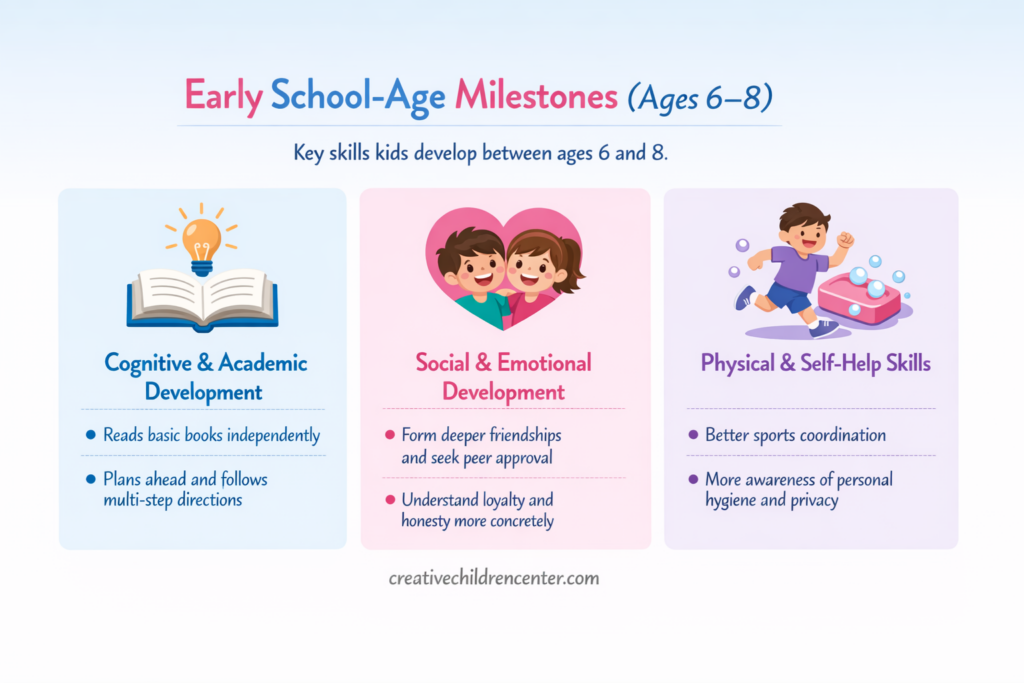
Early School-Age Milestones (Ages 6–8)
These middle years often bring visible leaps in confidence and cognitive maturity.
Cognitive and Academic Development
- Reads basic books independently
- Solves simple math problems logically rather than memorized
- Plans ahead and follows multi-step directions
- Understands time, sequences, and cause-and-effect
Here’s where things often go wrong: adults may focus solely on academic output—reading speed, grades—while missing the equally crucial growth in conceptual thinking and resilience.
Social and Emotional Development
Children at this stage:
- Value fairness and rules, sometimes rigidly (“That’s not fair!”)
- Form deeper friendships and seek peer approval
- Understand loyalty and honesty more concretely
- Show empathy but also growing self-consciousness
You’ll notice a subtle shift: children start needing space to process emotions privately. Respecting that space helps them trust you more deeply.
Physical and Self-Help Skills
Expect refinement rather than major leaps:
- Better sports coordination
- Ability to prepare simple snacks or organize clothes
- More awareness of personal hygiene and privacy
Encouraging independence here pays lifelong dividends.
Common Myths and Misconceptions About Development
Many parents unintentionally hold onto outdated or oversimplified ideas about child development, and clearing up these common myths can make a real difference in how children grow and thrive.
Myth 1: “Milestones Must Be Met On Time—or Something’s Wrong.”
Reality: Milestone charts are averages, not deadlines. A delay of a few months can be entirely normal if progress continues overall. What matters is the pattern—steady progress, curiosity, and engagement.
Myth 2: “Early Academic Skills Predict Future Success.”
In my experience, that’s one of the most damaging misconceptions. Early reading or counting is less predictive of success than play-based learning, emotional regulation, and social confidence. Rushing academics can backfire if it replaces hands-on exploration.
Myth 3: “A Child’s Personality Is Set Early.”
Personality traits emerge early, but they’re not fixed. Patience, resilience, and empathy grow through modeling and experience. A shy 3-year-old can become a confident, articulate 7-year-old with encouragement and safe social exposure.
Myth 4: “If My Child Isn’t Talking Yet, They’ll ‘Catch Up Later.’”
Sometimes that’s true—but sometimes it isn’t. Speech delays can stem from hearing issues, motor planning difficulties, or language exposure gaps. If your gut says something’s off, trust it. Early intervention consistently leads to better outcomes.
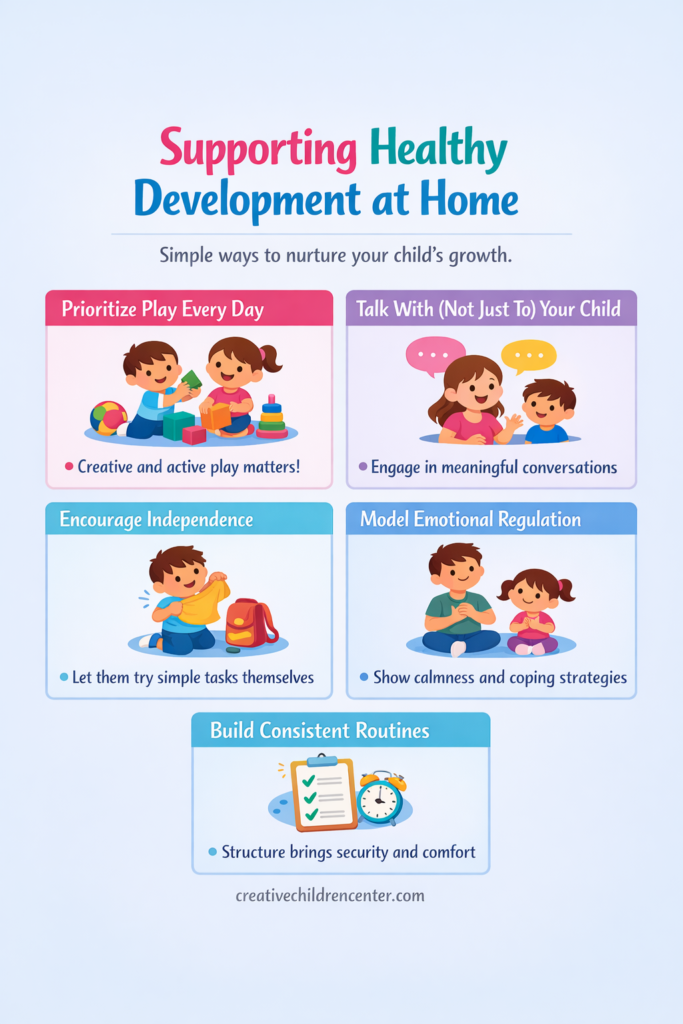
Supporting Healthy Development at Home
Supporting your child’s healthy development starts with simple, consistent interactions at home that nurture curiosity, build confidence, and strengthen your everyday connection.
1. Prioritize Play Every Day
Unstructured play—especially imaginative and outdoor play—is the foundation of healthy development. Climbing a tree or building a fort does more for coordination and creativity than any formal drill.
2. Talk With (Not Just To) Your Child
Simple conversation fuels language and social growth. Narrate what you’re doing, ask open questions, and give your child time to respond. Repetition and engagement matter more than complex vocabulary, especially in the critical 0–3 brain development window.
3. Encourage Independence
Let children make choices—what to wear, how to solve small problems. These decisions teach autonomy and confidence far better than constant direction.
4. Model Emotional Regulation
Children learn emotional control by watching how you handle stress. Saying “I’m frustrated, so I’m taking a deep breath” is far more powerful than telling them to “calm down.” This type of responsive, back-and-forth interaction resembles what researchers call serve and return, a key ingredient in healthy brain development.
5. Build Consistent Routines
Predictability creates security, especially for toddlers and preschoolers. Regular meals and bedtime rhythms help emotional stability and better sleep.
When to Seek Professional Guidance
Every parent worries about overreacting—none want to be “that” parent. But early action isn’t panic; it’s proactive support.
You might consider a developmental checkup if:
- Your child loses previously acquired skills
- Speech is unclear or nonexistent by age 3
- You notice little eye contact or social interest
- Fine motor skills remain very limited past age 5
- You feel “something’s off” despite reassurance
In my professional view, it’s better to ask than ignore your instincts. Most pediatricians now screen routinely for delays and can refer you to specialists like speech-language pathologists or occupational therapists if needed.
Next Steps for Parents

If you want to guide your child with confidence:
- Observe, don’t obsess. Keep an eye on patterns, not precise ages.
- Engage daily. Talk, play, and listen intently—it’s the best developmental therapy.
- Trust your intuition. You know your child better than any chart.
- Build partnerships. Teachers, caregivers, pediatricians—they’re allies, not judges.
- Enjoy the process. Growth doesn’t need to be rushed; it simply needs to be noticed.
Parenting is a long game, full of uncertainty but rich with discovery. If you focus on connection, curiosity, and consistent care, the milestones take care of themselves.
The Bigger Picture: Parenting Through Milestones
It’s easy to think of development as a ladder—each rung representing a new skill—but real growth looks more like a mosaic. Some areas develop quickly, others more slowly, and that’s perfectly natural. Each child’s journey unfolds in its own rhythm, shaped by personality, environment, and experience. Rather than racing toward checklist achievements, it helps to remember that balance across emotional, cognitive, and physical growth is what truly matters.
Above all, strong relationships form the foundation for every milestone. Children thrive when they feel safe, seen, and supported. Every moment of play, laughter, and connection lays the groundwork for lifelong learning. So when you catch yourself worrying that another child is reading chapter books while yours is still experimenting with scribbles, take a breath and ask instead: Is my child curious? Confident? Feeling loved and capable? Those answers say far more about your child’s healthy development than any timeline ever could.
At Creative Children Center LLC, that belief shapes everything we do. From our infant and toddler groups to our preschool, kindergarten, and school-age programs, each environment is designed to let children explore, discover, and grow at their own pace—without pressure or comparison. Our educators nurture every child’s individuality while strengthening the curiosity, confidence, and creativity that fuel lifelong learning.
If you’re looking for a childcare community that values both growth and heart, we invite you to learn more about our programs and see how we help little learners shine every day.