When parents think about preparing their children for school, they often focus on letters, numbers, and reading readiness. That’s understandable—those skills seem measurable and crucial for academic success. But what most parents don’t realize is that creative arts in early education can be just as foundational. Drawing, dancing, singing, and storytelling aren’t “extra” activities; they’re tools that help children understand the world, express themselves, and develop the very abilities that make learning possible.
In early education settings—from toddler groups to kindergarten classrooms—creative expression acts as both a mirror and a bridge. It reflects how children perceive the world and helps them connect ideas, emotions, and experiences in ways that no worksheet ever could. Over the past decade, educators, psychologists, and parents have begun to see creative art not as playtime filler but as essential brain-building work.
This article explores why creative arts matter, how they influence child development, and what families can realistically do at home to nurture that growth—even without fancy materials or professional training.
Why Creative Arts in Early Education Matter
At its core, creative arts in early education are about exploration. Through painting, singing, movement, and dramatic play, children learn to make choices, solve problems, and express ideas before they even have the words for them. These experiences support key developmental domains:
- Cognitive growth: Art activates both hemispheres of the brain, integrating creative thinking with logic and memory.
- Emotional development: Children learn self-awareness, empathy, and regulation through storytelling, pretend play, and music.
- Language skills: Describing their art and imaginary worlds expands vocabulary and communication abilities.
- Motor coordination: Fine-motor skills improve as children cut, glue, sculpt, and draw.
- Social learning: Group art projects encourage cooperation, patience, and respect for different perspectives.
What’s powerful about creative arts is how naturally they weave these domains together. As a preschooler paints a picture of their family, for instance, they’re recalling relationships (cognitive), discussing feelings (emotional), describing details (linguistic), and refining how to hold a brush (motor).
The Science Behind Artistic Learning
Decades of research confirm what experienced educators have long observed: children engaged in the arts are more adaptable learners. Much of this stems from how the brain processes sensory input.
Art nurtures neural plasticity—the brain’s ability to form new pathways. When a child mixes two colors to see what happens or choreographs a dance based on an emotion, they’re experimenting, hypothesizing, and adapting—all critical skills for lifelong learning.
Studies from early childhood programs such as Reggio Emilia and Montessori schools show that creative arts support better executive functioning: focus, flexibility, and working memory. These skills don’t just make children “good at art”; they make them strong learners across all subjects later on.
The Role of Teachers and Caregivers
The quality of an art experience depends less on the materials and more on the mindset of the adults guiding it. Teachers and parents serve as facilitators, not directors. The goal is not to produce a perfect craft but to encourage curiosity and self-expression.
Here’s what that looks like in practice:
- Asking open-ended questions such as, “Tell me about what you’re drawing,” instead of “What is that?”
- Valuing the process over the product—letting toddlers mix colors just to see what happens even if the paper turns brown.
- Providing varied materials—buttons, recycled boxes, fabric scraps—so children learn to see possibility in everyday items.
This approach fosters confidence. When children feel their ideas are respected, they take creative risks, and that risk-taking often carries over into problem-solving and other academic areas.
Myths and Misconceptions About Creative Arts
Here’s where things often go wrong: many families assume that art is “optional” or just for “talented” kids. That misconception quietly undermines a child’s opportunity for holistic growth.
Myth 1: “My child isn’t artistic.”
Every child is naturally creative—it’s adults who sometimes forget how to see it. Creativity is less about drawing beautiful pictures and more about thinking divergently: finding new uses for objects, asking unusual questions, or imagining alternative outcomes. A child building castles out of cereal boxes is exercising the same creative muscle as a painter blending watercolors.
Myth 2: “Art time distracts from academic learning.”
In reality, the opposite is true. Art integrates the very skills that support academics. When children make patterns with beads, they’re learning math sequencing. When they act out a story, they strengthen narrative understanding—an early reading skill. The arts don’t take time away from learning; they deepen it.
Myth 3: “Art requires expensive supplies.”
Some of the best creative experiences come from simple materials. Cardboard, chalk, kitchen utensils, and leaves can inspire richer exploration than any store-bought kit. What matters more than materials is space—both physical and emotional—for experimentation without fear of “messing up.”
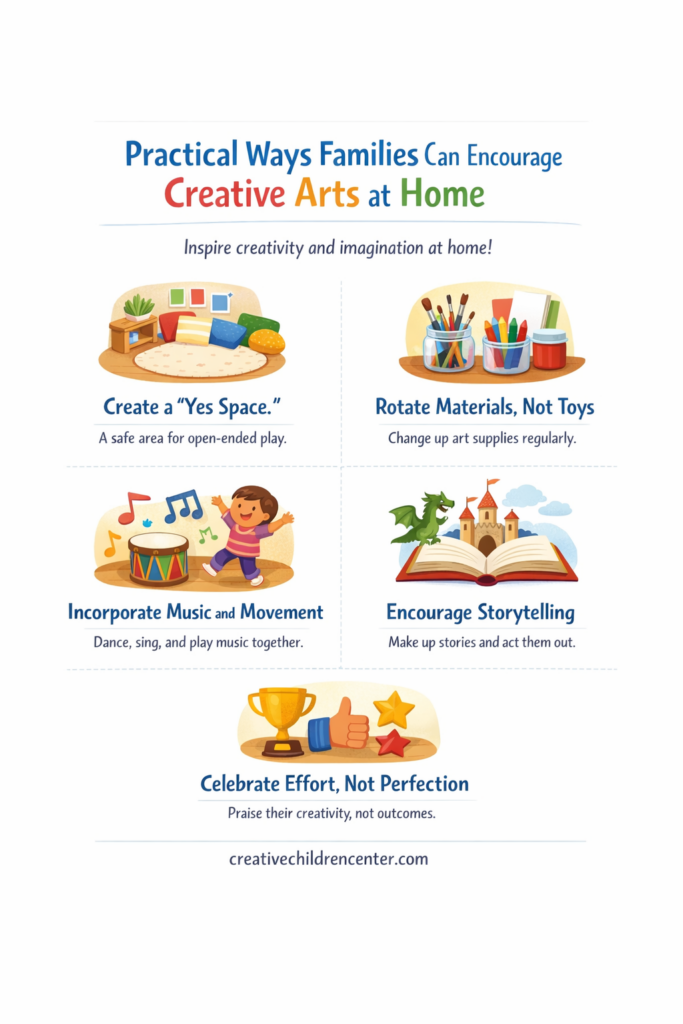
Practical Ways Families Can Encourage Creative Arts at Home
Supporting creative arts in early education doesn’t require an art degree or endless free time. It starts with intentional choices that fit naturally into everyday life.
1. Create a “Yes Space.”
Designate a small area where your child can explore freely without constant correction. Keep washable materials nearby—pencils, paper, glue, safe scissors—and let children decide what to make. The more they control the process, the deeper the engagement.
2. Rotate Materials, Not Toys
Instead of adding more toys, rotate different art materials every few weeks. Introducing clay one week and collage supplies the next keeps creativity fresh and sparks new ideas.
3. Incorporate Music and Movement
Song and rhythm are early learning superpowers. Singing together helps develop memory and language, while dancing strengthens body awareness and coordination. It’s perfectly fine if you can’t carry a tune—enthusiasm matters more than skill.
4. Encourage Storytelling
Ask children to narrate their drawings or invent stories about their favorite toys. This builds narrative thinking, confidence, and emotional understanding—all while having fun.
5. Celebrate Effort, Not Perfection
Focus praise on exploration (“You worked so hard on that pattern!”) rather than outcome (“That’s pretty”). It builds intrinsic motivation and teaches resilience when projects don’t go as planned.
The Emotional Language of Art
This is usually overlooked, but it matters deeply: art often gives children their first language for big emotions. A toddler who can’t verbalize sadness after saying goodbye to a parent might express it through colors or movement. A kindergartener exploring friendship conflicts might reenact them in a puppet show. The arts create a safe buffer between feeling and expression.
Parents who observe these moments without judgment gain unique insight into their child’s inner world. They learn when to step in with comfort and when to step back and let creativity do the healing.
How Schools Integrate Creative Arts
Strong early education programs don’t isolate creative arts—they integrate them across the curriculum. In a thoughtfully designed preschool or kindergarten:
- Art is part of science when children draw the plants they observe.
- Music connects to math through rhythm and patterns.
- Dramatic play supports language arts as children retell or invent stories.
This integrated model mirrors how the real world works—problems rarely come labeled “math” or “art.” Children trained to think through multiple lenses bring creativity into every field, whether engineering or storytelling.
Common Challenges for Parents

Even well-meaning parents face obstacles in supporting creativity at home. A few common ones include:
- Time pressure: Between work and routines, structured activities often take priority. Short, five-minute art breaks can still nurture creativity daily.
- Mess anxiety: Setting ground rules (“paint only on this mat”) helps maintain sanity without killing the fun.
- Comparisons: Every child develops creative confidence at their own pace. It’s not a race.
It helps to remember that creativity thrives on imperfection. The process is messy because growth is messy.
Conclusion: Turning Insight into Action
Every parent wants their child to thrive. Supporting creative arts in early education is a profoundly effective way to nurture curiosity, empathy, and confidence—traits that shape not just school success, but life success.
Here are a few realistic next steps families can take starting today:
- Set aside 15 minutes a day for an open-ended creative activity—drawing, storytelling, or singing together.
- Visit local art exhibits or children’s museums to expose young minds to visual diversity.
- Engage your preschool or daycare in conversations about how they integrate the arts into daily learning.
- Keep a “process portfolio” of your child’s creations to reflect their growth over time.
- Encourage unstructured creative time as much as structured academics.
With consistent support, creative exploration can become one of the most joyful and meaningful parts of early childhood.
For families seeking an environment that values imagination as much as academics, Creative Children Center LLC provides programs where creativity and education work hand in hand—nurturing young minds to think freely, feel deeply, and grow confidently.