
Families often begin to notice subtle signs during everyday routines. A toddler hesitates to climb onto a chair, a preschooler steers clear of playground structures, or a school-age child tires quickly during sports and gravitates toward screens. These moments may seem minor, but they often point to developing needs that gross motor skill activities are designed to support—needs that play a bigger role in a child’s growth than many expect.
In a world where busy schedules and screen time often replace free movement, incorporating gross motor skill activities into daily life takes a bit more intention than it once did. The encouraging part is that it doesn’t require anything complicated. With the right mix of play, space, and consistency, families can strengthen their child’s coordination, balance, and confidence in ways that feel natural and even fun.
This article explores what gross motor skills really are, how they evolve from toddlerhood through the school years, and which activities genuinely support development. It also points out common missteps and shares practical, real-world strategies that childcare professionals use every day.
What Gross Motor Skills Really Are (and Why They Matter)
Gross motor skills involve the large muscle groups that control movements like walking, running, jumping, balancing, and climbing. They form the foundation for nearly everything children do physically.
But this is usually overlooked, and it matters: gross motor development isn’t just about physical strength. It directly affects:
- Coordination and balance
- Confidence in physical environments
- Social participation (sports, group play)
- Even focus and classroom readiness
A child who feels physically capable is more likely to engage, explore, and take healthy risks. On the other hand, delays or gaps can quietly limit participation and self-esteem.
How Gross Motor Skills Develop by Age Group
Children don’t all follow the same timeline, and that’s important to acknowledge. Still, there are general patterns that guide what activities are most helpful.
Toddlers (1–3 years)
This stage is all about exploration and basic movement patterns.
Key developments:
- Walking steadily
- Beginning to run
- Climbing low structures
- Kicking a ball
At this age, repetition is critical. Toddlers learn through doing the same action again and again—often more than adults expect.
Preschoolers (3–5 years)
Movement becomes more coordinated and intentional.
Key developments:
- Jumping with both feet
- Balancing briefly on one foot
- Throwing and catching with more control
- Navigating playground equipment
Here’s where things often go wrong: adults introduce overly structured activities too early. Preschoolers still need play-based movement, not drills.
School-Age Children (6–12 years)
Skills become refined, and endurance improves.
Key developments:
- Complex coordination (sports, dance)
- Better balance and agility
- Increased strength and stamina
At this stage, children start comparing themselves to peers. Confidence becomes just as important as ability.
Practical Gross Motor Skill Activities That Actually Work
Effective gross motor skill activities aren’t just about keeping kids busy—they’re about combining movement, challenge, and fun in a way that feels natural, not forced.
For Toddlers: Building Confidence Through Movement
Keep activities simple, repetitive, and safe.
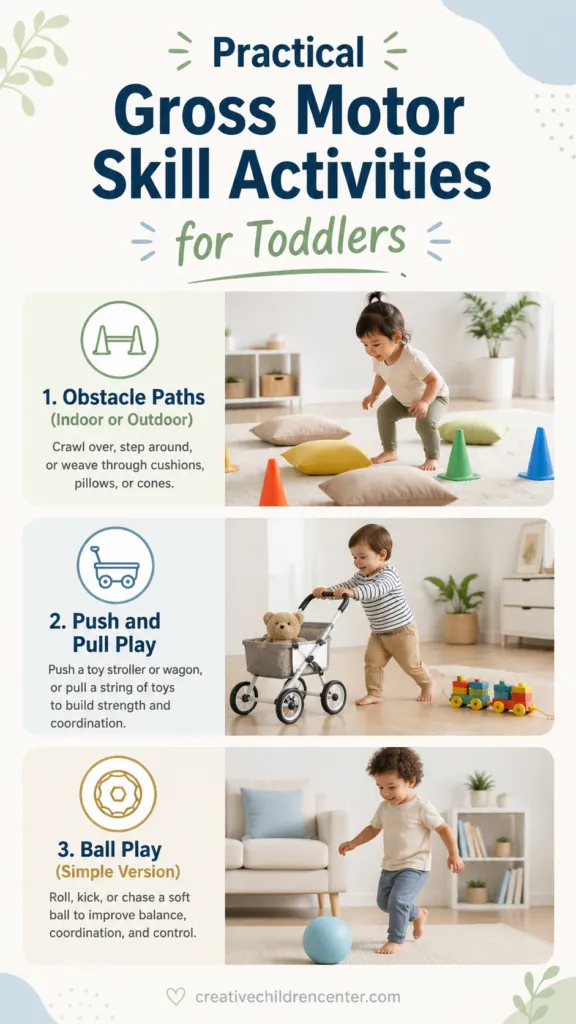
1. Obstacle Paths (Indoor or Outdoor)
Create a path using cushions, low stools, or taped lines on the floor.
- Step over objects
- Crawl under tables
- Walk along a “balance line”
This builds coordination and spatial awareness without overwhelming them.
2. Push and Pull Play
This is one of the most effective gross motor skill activities, using toy carts, boxes, or ride-on toys to help develop core strengt
3. Ball Play (Simple Version)
Rolling, gently kicking, or tossing a soft ball introduces coordination.
Best practice: Keep expectations low. Success at this age is participation, not precision.
For Preschoolers: Expanding Coordination and Balance
For preschoolers, gross motor skill activities are most effective when they introduce a bit more structure while still feeling playful and engaging.
1. Animal Walks
Ask children to move like different animals:
- Bear walk (hands and feet)
- Frog jumps
- Crab walk
These movements strengthen multiple muscle groups and improve coordination.
2. Balance Challenges
Use simple setups:
- Walk along a taped line
- Stand on one foot while counting
- Step across “stepping stones”
This is usually overlooked, but balance is foundational for nearly all physical skills.
3. Throwing and Catching Games
Start with larger, softer balls.
- Toss into a basket
- Partner throw and catch
- Target games
Here’s the nuance: accuracy develops slowly. Focus on effort, not results.
For School-Age Children: Strength, Agility, and Endurance
For school-age children, gross motor skill activities should offer variety and increasing levels of challenge to build strength, agility, and endurance while keeping them engaged.
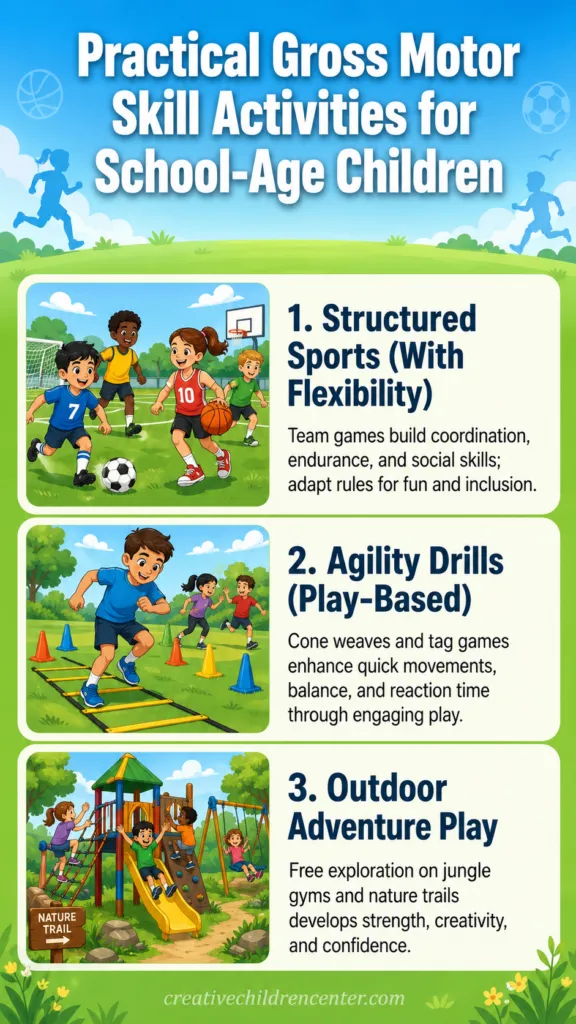
1. Structured Sports (With Flexibility)
Sports like soccer, basketball, or swimming can be valuable—but only if the environment is supportive.
Trade-off to consider:
- Competitive leagues can build skills
- But they can also discourage children who feel less capable
A balance between structured and free play often works best.
2. Agility Drills (Play-Based)
Use cones or markers to create:
- Zig-zag runs
- Shuttle runs
- Quick direction changes
These improve speed, coordination, and reaction time.
3. Outdoor Adventure Play
Climbing, biking, hiking, or playground exploration.
This is where real-world movement shines. It challenges the body in ways structured environments often can’t replicate.
Common Mistakes Families Make (and Why They Happen)
Even well-intentioned parents can unintentionally limit development.
1. Prioritizing Organized Activities Too Early
It’s tempting to enroll children in classes or sports as soon as possible. But younger children benefit more from free movement than structured instruction.
Why this happens:
- Desire to “get ahead”
- Social pressure
Reality: foundational skills come from unstructured play.
2. Overcorrecting or Overteaching
Constantly telling a child how to move—“Hold it like this,” “Do it this way”—can reduce confidence.
Better approach:
- Demonstrate once
- Let the child explore
Children learn through trial and error, not perfection.
3. Underestimating the Role of Repetition
Adults often get bored before children do.
But repetition is how motor patterns develop. What looks repetitive is actually essential practice.
4. Avoiding Risk Entirely
Safety matters, but eliminating all risk limits growth.
Climbing, balancing, and jumping all involve manageable risk—and that’s part of how children build confidence and judgment.
A Common Misconception: “Active Kids Don’t Need Support”
Many assume that if a child is constantly moving, their gross motor skills are developing just fine.
That’s not always true.
A child may be active but still:
- Avoid certain movements (like balancing or climbing)
- Compensate with less efficient patterns
- Struggle with coordination in more complex tasks
The real issue is quality of movement, not just quantity.
For example:
- Running is great, but if a child can’t stop or change direction easily, agility needs attention
- Climbing is helpful, but if balance is weak, other activities should complement it
The takeaway: activity alone isn’t enough—variety matters.
How to Build a Balanced Routine at Home

Families don’t need elaborate setups or expensive equipment. What matters is consistency and variety.
A Simple Weekly Framework
Daily (10–20 minutes):
- Free outdoor play
- Basic movement (running, climbing, jumping)
2–3 times per week:
- Focused activity (obstacle course, ball games, balance tasks)
Weekly:
- A longer session (park visit, bike ride, family activity)
This approach keeps things manageable while covering key skill areas.
When to Adjust or Seek Extra Support
Every child develops differently, but some signs may indicate the need for closer attention:
- Frequent falling beyond expected age
- Avoidance of physical play
- Difficulty with basic coordination tasks
- Quick fatigue during movement
That said, context matters. A child who’s simply less interested in sports may still be developing normally.
When in doubt, observation over time is more useful than reacting to a single moment.
Creating an Environment That Encourages Movement
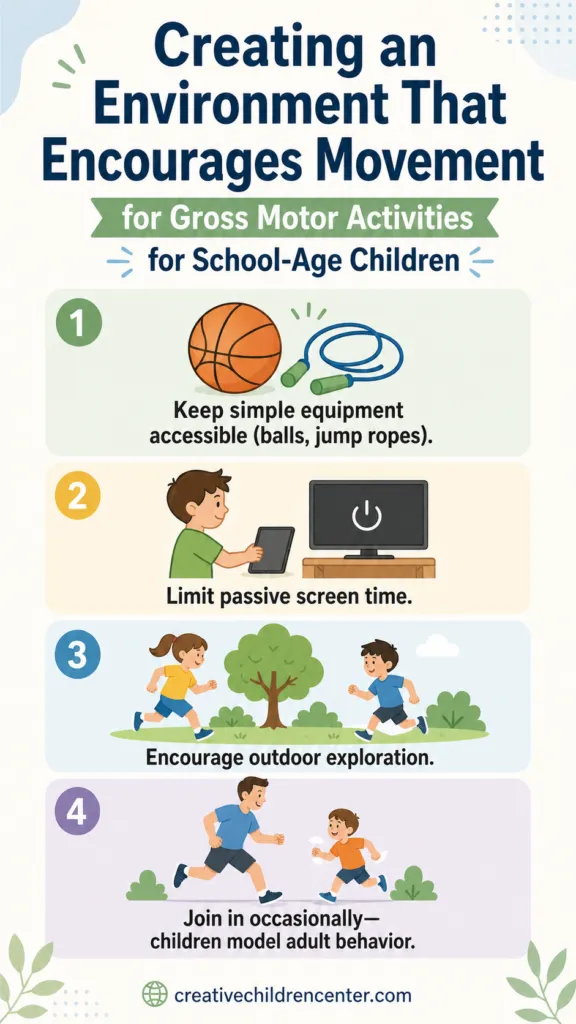
Children are more likely to develop strong motor skills when movement is part of daily life—not just a scheduled activity.
Practical ways to support this:
- Keep simple equipment accessible (balls, jump ropes)
- Limit passive screen time
- Encourage outdoor exploration
- Join in occasionally—children model adult behavior
This is usually overlooked, but the environment often matters more than specific activities.
Final Thoughts
Gross motor development doesn’t require perfection, expensive programs, or constant supervision. What it does require is thoughtful exposure to a variety of movements, patience with repetition, and an understanding that progress isn’t always linear. Children build these skills over time, often in ways that aren’t immediately obvious, but the long-term impact on confidence, coordination, and overall well-being is significant.
For families looking for more structured support, a well-designed program can complement what happens at home. At Creative Children Center, experienced educators integrate gross motor skill activities into daily routines in a way that feels natural, engaging, and developmentally appropriate. The goal isn’t just to keep children active—it’s to help them move with confidence, curiosity, and capability as they grow.