

Play based learning is not just “letting kids play”—it is a powerful, research-backed way for young children to build the social, emotional, physical, and thinking skills they need for school and life. In early education, play is the child’s natural language, and high‑quality programs use it intentionally to support real learning in a joyful, developmentally appropriate way.
What Is Play Based Learning?
Play-based learning is an approach where children learn through meaningful, hands-on play experiences that are guided, supported, or thoughtfully set up by adults. Instead of sitting for long lectures or worksheets, children explore, experiment, and problem-solve through activities that feel fun and engaging to them.
In a play-based classroom, you’ll often see:
- Children choosing between learning centers like blocks, dramatic play, art, science, or reading.
- Teachers setting up invitations to play—such as a pretend grocery store, a sensory bin with scoops and funnels, or a building challenge with different materials.
- Adults watching closely, asking open-ended questions, and gently extending children’s ideas rather than directing every step.
The key difference between “just play” and play-based learning is intentionality. Children still play, but teachers plan environments, materials, and interactions that target important skills—like language, self-control, early math, or cooperation—inside that play.
Why Play Matters So Much in Early Childhood
Young children do not learn in the same way that older students do. Before about age 7, most kids learn best by doing: touching, moving, pretending, talking, and trying things out. Play uses this natural drive and turns it into a powerful engine for development.
Through play, children:
- Practice new skills over and over (like pouring water, stacking blocks, or taking turns) until those skills become automatic.
- Make sense of their experiences—playing “family,” “school,” or “doctor” lets them process emotions, routines, and changes.
- Take safe risks, experiment with ideas, and learn from mistakes in a low‑pressure environment.
For parents, this means that what looks like “just play” is often the hardest work your child is doing all day. A child building a tower is learning about balance, cause and effect, patience, and frustration tolerance—all under the surface of a seemingly simple activity.
The Core Benefits of Play-Based Learning
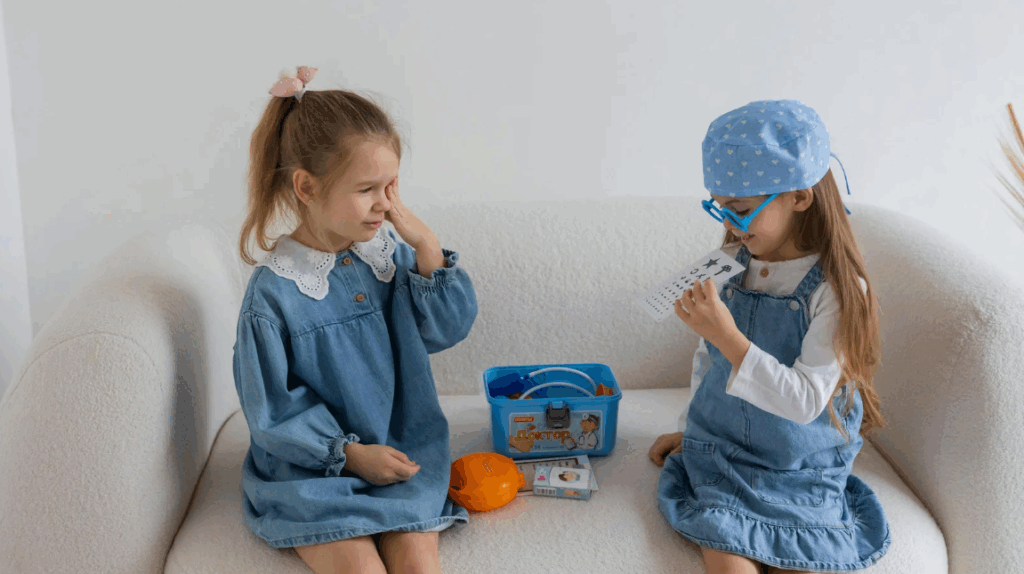
Play-based learning supports the whole child, not just academics. Below are some of the most important benefits, broken down by developmental area.
1. Social and emotional growth
Play is the main way young children learn how to be with other people. In group settings like preschool, childcare, or kindergarten, play creates countless chances to practice social and emotional skills.
Through play, children:
- Learn to share, take turns, and negotiate (“I’ll be the doctor this time, you can be the doctor next time.”).
- Experience and manage big feelings, like disappointment when a game doesn’t go their way or pride when they complete a challenge.
- Develop empathy by stepping into another role or perspective during pretend play.
These social-emotional skills—self-control, patience, cooperation, and empathy—are some of the strongest predictors of later success in school and relationships. Worksheets cannot teach them; repeated, supported play experiences can.
2. Language and communication skills
Play naturally invites conversation. Children talk to each other while they build, pretend, and explore, and teachers can join in to introduce new vocabulary and richer language.
In a play-based setting, children:
- Hear and use new words tied to real experiences (measuring, mixing, predicting, balancing, floating, sinking).
- Practice storytelling as they act out pretend scenarios or explain what they’re building.
- Learn the back-and-forth of conversation—listening, responding, asking questions, and clarifying ideas.
Even quiet children often become more talkative when they are deeply engaged in play, because they feel safe and motivated to share what they are doing.
3. Cognitive and early academic skills
Play supports the thinking skills that sit underneath academic learning. Instead of memorizing random facts, children use play to build strong mental foundations for problem-solving, attention, and flexible thinking.
Examples of cognitive and early academic growth in play:
- A child sorting buttons by color or size is practicing classification, an early math skill.
- Building a bridge with blocks and then adjusting it when it falls teaches cause and effect, basic engineering, and perseverance.
- Playing “restaurant” introduces early literacy (menus, writing orders) and math (counting, money, “more” and “less”).
When children reach formal academics—reading, writing, and more advanced math—they can learn more easily because their brains have already been exercised through playful problem-solving.
4. Physical and motor development
Play-based learning constantly engages a child’s body. Young children need movement to develop coordination, strength, and body awareness.
During play, children:
- Build gross motor skills by running, climbing, jumping, dancing, and navigating playground structures.
- Develop fine motor skills by drawing, cutting, threading beads, building with small blocks, and manipulating small objects.
- Improve hand-eye coordination through activities like pouring, catching, stacking, and aiming.
Strong motor skills support later academic work too, such as writing, using scissors, and participating in classroom routines without fatigue or frustration.
Types of Play in Early Education
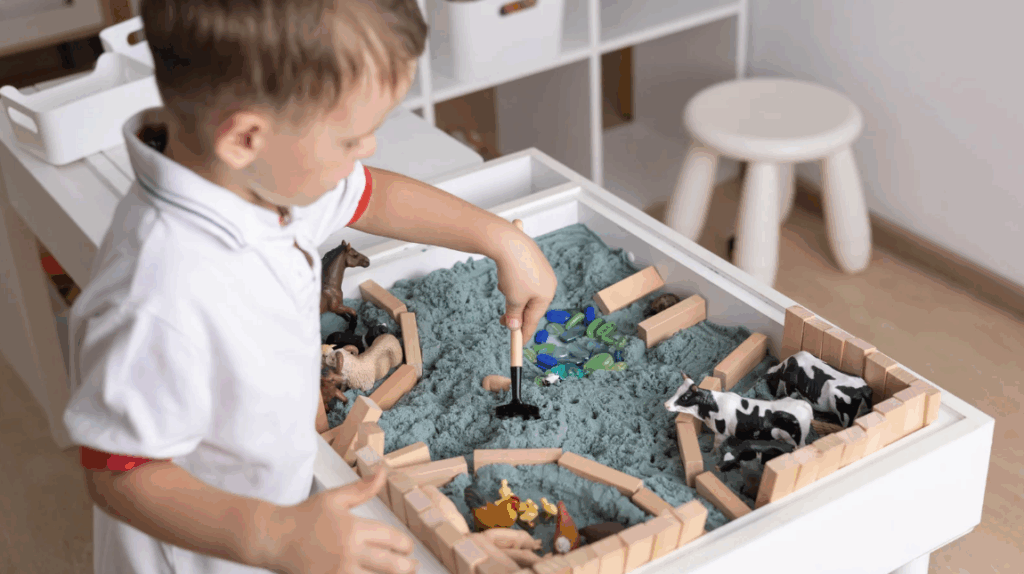
Not all play looks the same. Understanding different types of play helps parents and educators see what children are learning in each.
Common types include:
- Free play: Children choose what to play and how to play it, with minimal adult direction. This builds independence, creativity, and decision-making.
- Guided play: Adults set up a goal or structure (e.g., “Can you build a bridge that holds three animals?”) but children decide how to achieve it. This blends exploration with gentle academic focus.
- Structured games: Simple rules or steps (like “Simon Says” or matching card games) help children learn to follow directions, remember sequences, and cope with winning and losing.
- Pretend/dramatic play: Children act out roles (family, doctor, teacher, chef) and use imagination to explore emotions, social roles, and real-world situations.
- Sensory play: Activities using sand, water, dough, rice, and other materials let children explore textures, temperature, weight, and movement, strengthening both brain and body connections.
- Outdoor and nature play: Digging in dirt, collecting leaves, climbing, and exploring natural spaces builds physical strength, curiosity about the world, and resilience.
High-quality early education programs intentionally offer a mix of these play types across the day.
How Teachers Make Play “Real Learning”
One common worry from adults is that if children are “just playing,” they won’t be ready for the academic demands of school. The reality is that the quality of adult interaction during play is what turns everyday moments into powerful learning opportunities.
Effective educators in a play-based classroom:
- Design the environment carefully, choosing materials and centers that support specific skills (e.g., puzzles for spatial reasoning, pretend store for math and language).
- Observe children closely to see what they’re interested in and where they might need scaffolding.
- Ask open-ended questions like “What do you think will happen if…?” or “How could we solve this problem?” rather than giving quick answers.
- Model language, social skills, and problem-solving strategies in the moment.
- Gently introduce new ideas or vocabulary inside the play children already care about.
For example, if children are building a city with blocks, a teacher might add paper and markers so they can make signs, maps, or labels. This subtle shift brings in literacy and planning without shutting down the joy of building.
Play vs. “Academic” Learning: A False Choice
Many families feel torn between wanting a childhood filled with play and wanting their child “ahead” academically. This often leads to pressure for more worksheets, early reading drills, or rigid schedules in preschool and kindergarten.
In reality:
- Children who develop strong social-emotional skills, language, and problem-solving through play often handle academic demands better later on.
- Pushing formal academics too early can create frustration, anxiety, and a negative attitude toward school.
- Play-based programs can still explicitly support early literacy and numeracy—through stories, songs, rhymes, counting games, and meaningful print in the environment—without sacrificing developmentally appropriate practice.
Instead of asking “play or academics,” a more helpful question is: “How can this play experience support my child’s long-term learning and well-being?”
What Play-Based Learning Looks Like at Different Ages
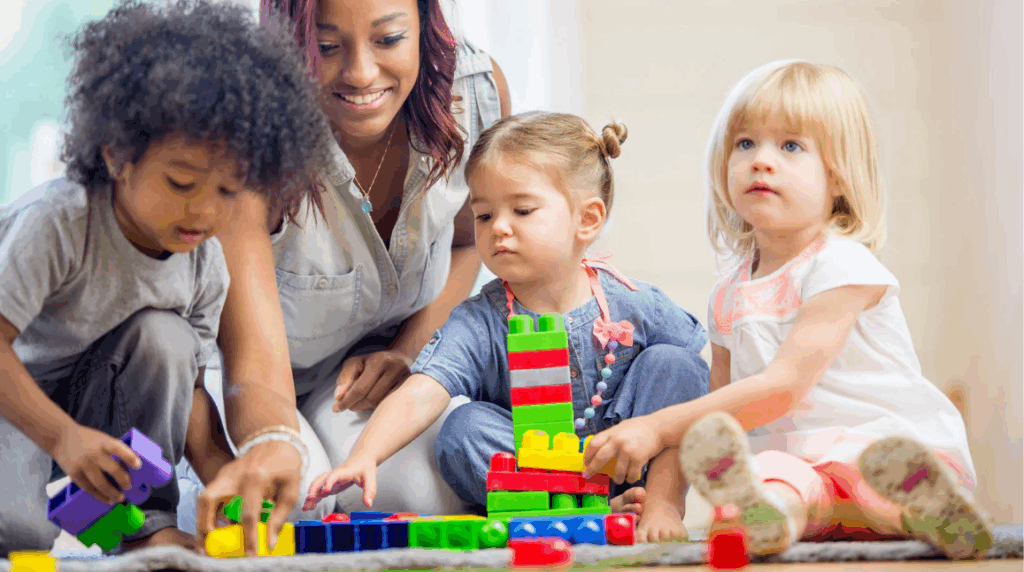
Play-based learning evolves as children grow. Here’s how it often looks across common early childhood stages.
Toddlers (around 1–3 years)
For toddlers, play is mostly about sensory exploration and simple cause and effect.
You might see:
- Dumping and filling containers with blocks, water, or sand.
- Pushing, pulling, or crawling through tunnels.
- Simple pretend actions (feeding a doll, pretending to talk on a phone).
- Parallel play—children playing side by side rather than with each other.
Adults support learning by:
- Providing safe spaces to explore.
- Offering simple language (“You filled the bucket. Now it’s heavy!”).
- Keeping routines predictable, with plenty of time for free movement and exploration.
Preschoolers (around 3–5 years)
Preschoolers become much more social, imaginative, and verbally expressive in their play.
You might see:
- Complex pretend scenarios with roles, rules, and storylines.
- Cooperative play—children negotiating roles, sharing materials, and building together.
- Interest in counting, sorting, sequencing, and early writing in the context of play.
Adults support learning by:
- Creating rich centers (dramatic play, blocks, art, science) with rotating materials.
- Asking deeper questions and offering new challenges tied to children’s interests.
- Intentionally weaving in early literacy and numeracy through playful activities.
Kindergarten and early school-age (around 5–7 years)
Even as academics increase, play remains crucial. Older children still benefit from hands-on, exploratory learning and imaginative play.
You might see:
- Board games and structured games with more complex rules.
- Project-based play—designing a simple experiment, building a model, or planning a performance.
- More sophisticated pretend play and problem-solving with peers.
Adults support learning by:
- Protecting time for play and exploration alongside more formal lessons.
- Using playful approaches to introduce academic concepts (math games, science experiments, storytelling).
- Encouraging collaboration, leadership, and independent problem-solving within group play.
How Parents Can Support Play-Based Learning at Home
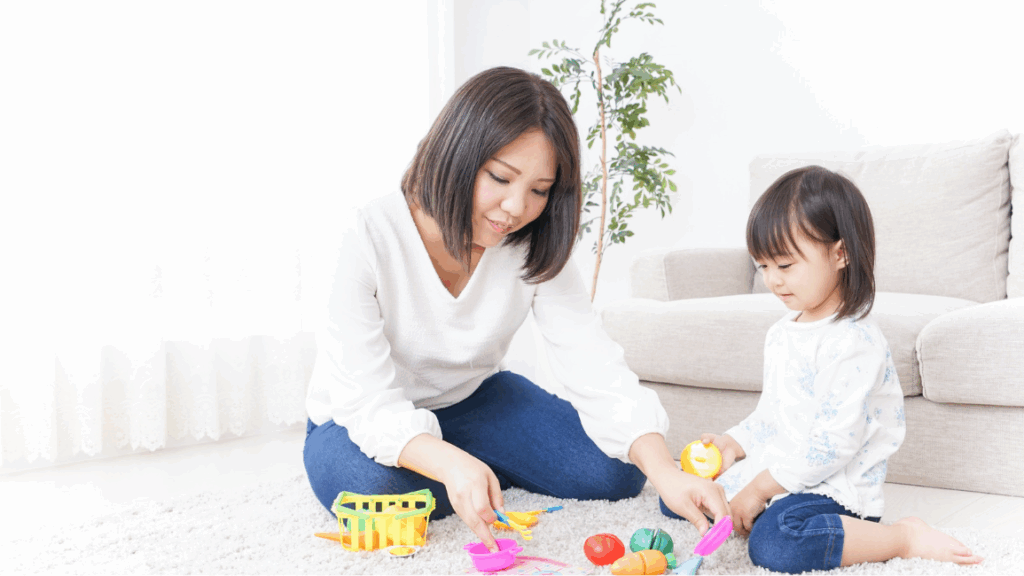
You do not need a perfectly stocked playroom or expensive toys to support meaningful play. Most of the best learning happens with simple materials and a responsive adult.
Practical ways to support play at home:
- Protect unhurried time: Avoid over-scheduling; allow stretches of time where your child can get deeply absorbed in play.
- Offer open-ended materials: Blocks, boxes, playdough, art supplies, dress-up clothes, and household items can become anything in a child’s imagination.
- Follow your child’s lead: Join their play when invited; let them be the director and you the supportive partner or “assistant.”
- Narrate and extend: Comment on what you see (“You’re sorting all the cars by color.”) and add gentle challenges (“I wonder how many red cars you have.”).
- Embrace repetition: Children often repeat the same game or scenario many times. This is how they master skills and work through feelings.
- Limit screens when possible: Screens tend to provide finished images and stories, whereas play asks children to create their own.
Your presence, curiosity, and patience matter more than any specific toy or activity.
Questions Parents Often Ask About Play-Based Programs
“Will my child be ready for kindergarten if they mostly play?”
High-quality play-based programs are designed to support all the skills children need for kindergarten readiness: language, social-emotional skills, self-regulation, early literacy and numeracy, fine motor skills, and confidence. When a program is intentional, the daily play experiences are actually preparation for school, not a distraction from it.
“How can I tell if a program is truly play-based and not just chaotic?”
When you visit a classroom, look for:
- Children actively engaged, not just wandering or waiting for directions.
- A variety of well-organized centers and materials that invite exploration.
- Teachers interacting at children’s level, asking questions, and expanding ideas.
- A balance of free choice and gentle structure (such as morning meeting, small groups, and routines).
The room may be lively and noisy at times, but there should be a sense of purpose and calm, not constant confusion or stress.
“What about children who don’t seem to know how to play?”
Some children need extra support learning how to play—especially if they have had fewer opportunities for unstructured time or if they find social situations challenging. Good teachers:
- Model how to use materials and join games.
- Pair children thoughtfully so they can learn from peers.
- Stay close to coach through conflicts or uncertainty.
Over time, even hesitant children can become more confident players.
Key Takeaways for Parents and Educators
Play-based learning is far more than a “nice extra” in early education—it is the engine that powers a child’s social, emotional, physical, and cognitive growth. When children are given time, space, and support to explore, pretend, build, and experiment, they gain confidence in their abilities, learn to navigate big feelings, and develop the problem-solving skills they need to thrive in kindergarten and beyond.
At Creative Children Center LLC, play is at the heart of every day—carefully planned, lovingly guided, and thoughtfully connected to real learning. In our classrooms, children don’t just sit and listen; they question, explore, create, and collaborate in an environment that feels like a second home. If you’re ready to give your child a joyful, play-rich foundation for school and life, schedule a tour or contact Creative Children Center today to learn more.