

On any given morning, a preschool parent faces a familiar scene — a half-built block tower teetering on the coffee table, water cups overturned in an “experiment,” and a child endlessly asking why. It’s easy to see play as chaos. But for an educator or parent in the know, that chaos is gold — it’s early-stage scientific thinking in action.
The challenge most families face isn’t a lack of interest from their kids, but knowing how to channel that natural curiosity into meaningful, hands-on learning. That’s where STEM activities for preschoolers come in — simple experiments and play setups that build foundational skills for science, technology, engineering, and math without losing the joy of discovery.
In this guide, we’ll unpack why STEM learning starts much earlier than people think, share activity ideas that actually work in real homes, and tackle common misconceptions that often steer well-meaning parents off course.
Why Early STEM Learning Matters More Than You Think
Preschool brains are wired for experimentation. Between ages 3 and 5, children form neural connections at lightning speed, building early pathways for logic, reasoning, and creativity. When introduced gently to STEM concepts through play, they don’t just learn facts — they learn how to learn.
Parents often underestimate how capable preschoolers are. They think “science” means test tubes or complicated terms. But at this stage, it’s far simpler: predicting, comparing, measuring, problem-solving. Pouring water into containers of different shapes, watching shadows move, or building bridges out of cardboard teaches real scientific habits.
What’s most important isn’t the complexity of the activity — it’s the thinking behind it. The goal isn’t to create mini-engineers overnight, but to nurture curiosity, persistence, and the courage to ask questions.
The Foundations: What Makes a Great STEM Activity

To make STEM activities meaningful (and not just messy), a few key ingredients matter:
- Curiosity-driven exploration. The activity should start with a question or “what if?” moment, not a rigid set of steps.
- Hands-on engagement. Preschoolers learn best through touch, movement, and experimentation.
- Opportunities for prediction and discussion. Asking questions like “What do you think will happen?” makes learning stick.
- Room for mistakes. A “failed” bridge or a color mix gone wrong is part of learning — not something to correct immediately.
Here’s where things often go wrong: adults tend to jump in too quickly to fix or explain. Try holding back a bit longer. Give your child time to observe, reflect, and come to their own conclusions first. That patience is what transforms a simple toy into a learning tool.
Easy Everyday STEM Activities for Preschoolers
Preschoolers learn best when they do things themselves — pouring, building, testing, mixing, and wondering. These 10 STEM activities for preschoolers turn natural play into real exploration. Your job as the parent? Set up the stage, then step back and watch them figure things out.
1. Sink or Float Science
Turn ordinary water play into mini-experiments about why some things sink and others float.
What to do:
- Let your child fill a bowl or small tub with water.
- Ask them to collect random items from around the house (a crayon, spoon, sponge, coin, leaf).
- Before dropping each item, have them guess what will happen — will it float or sink?
- Watch together and have your child sort the “sinkers” and “floaters.”
- Try changing the water by adding salt or soap bubbles, then test again.
Purpose:
Encourages prediction, sorting, and early understanding of properties like weight, shape, and material — all through hands-on discovery.
2. Paper Bridge Builders
Your child becomes an engineer trying to make a paper bridge strong enough to hold “cargo.”
What to do:
- Ask your child to find two stacks of books or boxes and lay them apart.
- Give them a sheet of paper and small objects to test (toy cars, coins, etc.).
- Let them lay the paper across like a bridge and add weight slowly.
- When it sags, ask, “How could you make it stronger?” — encourage folding or layering.
Purpose:
Develops design thinking, persistence, and problem-solving — essential early engineering skills — with decisions led by the child.
3. Nature Pattern Hunt
Turn a simple walk into a math and science adventure where patterns come alive.
What to do:
- Tell your child they’re “pattern detectives.”
- On a walk, let them collect small items (leaves, rocks, sticks, flowers).
- Spread them out and ask them to design patterns — leaf–rock–leaf–rock, or big–small–big–small.
- Challenge them to invent their own pattern “rules.”
Purpose:
Builds pattern recognition, counting, and organization — core early math and logic skills that grow naturally through creative play.
4. Ice Excavation Rescue
A sensory activity that lets your little scientist free a trapped toy using creativity and problem-solving.
What to do:
- Freeze small toys overnight in bowls or ice trays.
- The next day, hand your child tools (droppers, spoons, warm water, salt).
- Let them decide how to melt the ice most efficiently.
- Encourage experimenting: “What happens if you sprinkle salt or pour warm water here?”
Purpose:
Promotes observation, patience, and early physics through trial and error — with children leading the strategy.
5. Sound Explorers
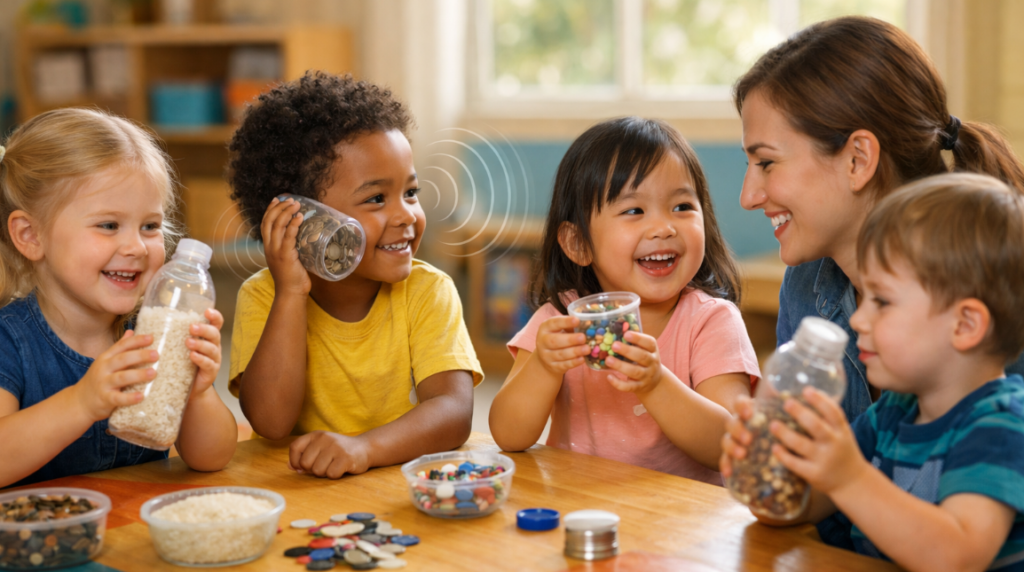
Perfect for energetic kids who love noise — this turns sound-making into a real experiment.
What to do:
- Let your child fill bottles or cups with different materials (rice, coins, beans, buttons).
- Have them shake, tap, and listen to compare sounds.
- Encourage them to describe: “Which one sounds like rain? Which is loudest?”
- Ask them to design their own “instrument” and perform a rhythm.
Purpose:
Builds observation and classification skills by recognizing how different materials create sound — a hands-on intro to physics and music.
6. Shadow Tracing Adventure
A creative way for your child to explore sunlight, time, and movement while drawing outside.
What to do:
- On a sunny morning, bring paper and crayons outside.
- Have your child place a favorite toy on the paper and trace its shadow.
- Leave it for an hour, then come back to trace again — what changed?
- Let them guess why shadows move. (No need for perfect answers — curiosity is the goal.)
Purpose:
Builds understanding of light and time while improving focus and observation — plus it feels like drawing magic.
7. Balloon Rocket Race
Let your child take charge of building a “rocket” that moves using air power alone.
What to do:
- Thread a straw through a long piece of string and stretch it across the room (tie between chairs).
- Blow up a balloon and tape it to the straw — but don’t tie the end.
- Let your child count down and release the balloon “rocket.”
- Experiment: bigger balloons, higher angles, more air — what changes?
Purpose:
Introduces motion, air pressure, and experimentation — the thrill of science in action that gets kids thinking like engineers.
8. Recycled Tower Challenge
A creative construction challenge where your child becomes the lead architect.
What to do:
- Collect safe recyclables: cardboard boxes, tubes, cups, bottle caps.
- Challenge: “Can you build the tallest or strongest tower?”
- Let them experiment with stacking, balancing, and rebuilding.
- Ask reflective questions like, “Why did this one fall faster?”
Purpose:
Teaches problem-solving, persistence, and spatial reasoning — all while building hand-eye coordination and patience.
9. Color Mixing Lab
A colorful, self-led “science lab” for curious little artists.
What to do:
- Give your child three clear cups of water and food colors: red, yellow, and blue.
- Supply empty cups, droppers, or spoons for mixing.
- Let them create their own color combinations and name them (“sunshine orange,” “stormy green”).
- Use a flashlight to see how light changes color appearance.
Purpose:
Encourages creative experimentation, observation, and an understanding of color relationships — where art meets science.
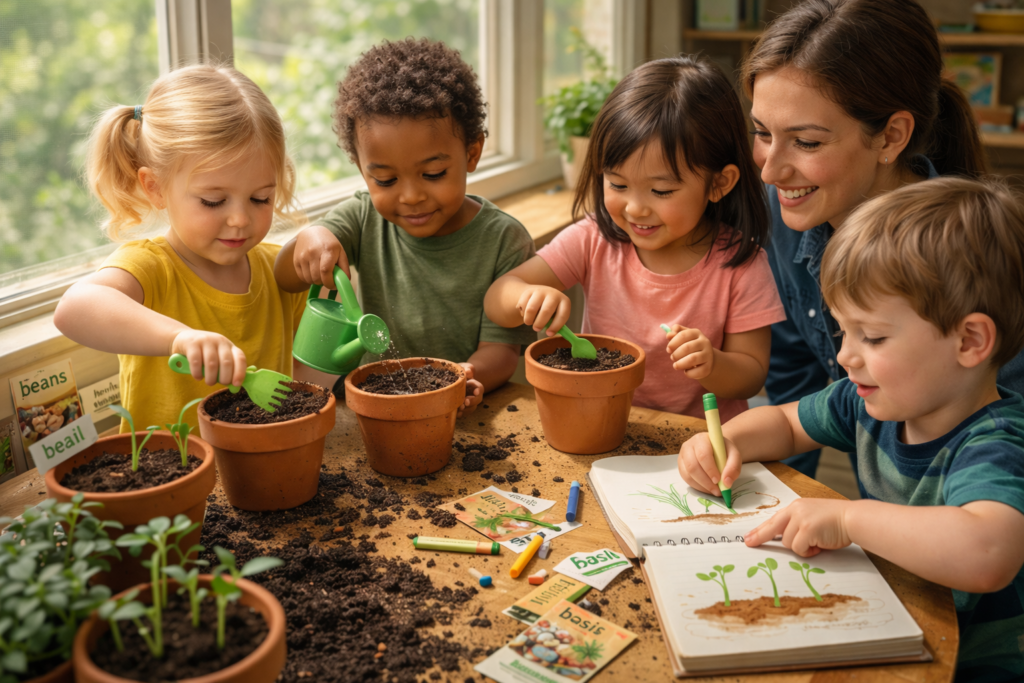
10. Mini Garden Scientists
A patient, ongoing experiment your child is fully responsible for.
What to do:
- Give them small pots, soil, and seeds (beans or herbs work best).
- Help them plant and label each seed.
- Let them water daily and record changes in a “plant journal” using drawings.
- After a week, ask what they notice: color, size, direction of growth.
Purpose:
Teaches care, measurement, and the basics of living systems — plus a genuine sense of pride in something they’ve grown themselves.
Common Misconceptions About STEM for Preschoolers
Let’s clear up a few myths that often limit meaningful learning at this stage.
Myth #1: “STEM is too advanced for preschoolers.”
This one’s everywhere, but it’s simply not true. Preschoolers are natural pattern finders and problem-solvers. The key is in how you frame activities — in stories, play, and questions, not lectures or worksheets.
Myth #2: “You need expensive kits or lab tools.”
In reality, the best STEM activities for preschoolers can happen with cups, cardboard, and curiosity. Think process over product: how your child explores matters far more than what they build.
Myth #3: “If they’re not interested, don’t push it.”
There’s nuance here. While forcing a topic rarely works, gentle reintroduction through a different angle often helps. A child bored by counting blocks might light up when counting seeds for a pretend garden.
In early education, interest is elastic, and parents can guide it through context.
Guiding Without Over-Directing

Preschool STEM is less about instruction and more about invitation. Think of yourself not as a teacher, but as a co-discoverer.
Here are a few strategies that balance guidance and freedom:
- Start with curiosity, not answers. Ask questions before showing how something works.
- Model safe hesitation. It’s okay to say, “I’m not sure — let’s find out.” This models scientific integrity.
- Let mess happen (within reason). Exploration often looks disorganized; learning hides in that mess.
- Reflect after play. A brief recap helps solidify patterns (“Remember yesterday when the ice melted faster in warm water?”).
Families that normalize wondering aloud raise children who stay curious longer — and curiosity is the real metric that matters.
Conclusion: Doing Less, But Noticing More
The secret to nurturing a love for science and problem-solving isn’t doing more — it’s noticing more. When parents see daily play as a laboratory for discovery, the house itself becomes a learning environment.
To recap, here are five realistic next steps families can take today:
- Choose one simple activity (like sink or float) and explore it deeply rather than rushing through several.
- Integrate open-ended questions into daily routines.
- Focus on the process — not whether the project “works.”
- Rotate toys occasionally to renew curiosity.
- Visit your local nature park or library’s STEM corner for inspiration.
The long-term payoff is subtle but immense: children who experiment confidently, think critically, and stay curious throughout life.
If you’re based in our area, Creative Children Center LLC offers play-based STEM programs designed exactly for this stage of growth — where imagination and exploration meet early learning foundations. It’s a great step if you’re ready to see structured curiosity in action.