
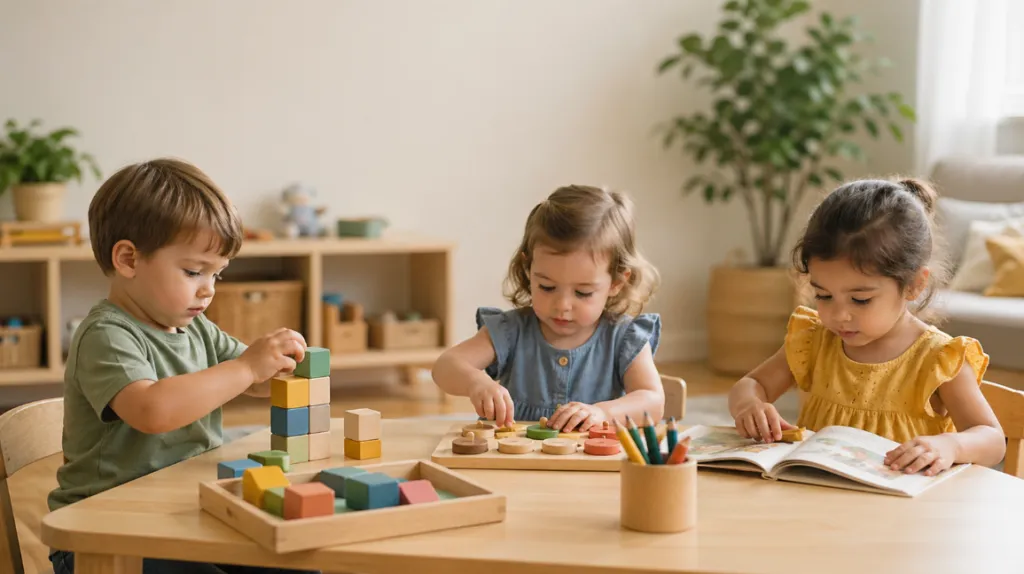
For many families, the idea of “quiet time” sounds ideal—calm, focused children engaged in something meaningful while adults catch their breath or handle other responsibilities. But in practice, it often turns into screen time, boredom, or constant interruptions. Parents and caregivers frequently ask the same question: How do you keep children quietly engaged without sacrificing learning or development?
This matters more now than ever. Children are navigating a fast-paced, highly stimulating world, and the ability to slow down, focus, and engage independently is becoming a critical life skill. Quiet time isn’t just about rest—it’s an opportunity to build concentration, creativity, and problem-solving.
A well-run childcare center sees this daily. When quiet time is structured intentionally, children don’t just stay occupied—they grow. This article walks through 12 practical, age-appropriate quiet time activities that encourage learning, along with insights on how to use them effectively at home.
What Quiet Time Should Actually Do
Quiet time is often misunderstood as simply “keeping kids busy.” That’s where things often go wrong.
In reality, effective quiet time should:
- Promote independent thinking
- Encourage sustained attention
- Support emotional regulation
- Offer a balance between structure and choice
It’s not about silence for silence’s sake. Some children will whisper, hum, or move slightly—that’s normal. The goal is low-stimulation engagement, not rigid stillness.
Common Mistakes Families Make
Before diving into activities, it helps to understand why quiet time sometimes fails:
Over-reliance on screens
Screens are easy, but they rarely build focus or creativity in the same way hands-on activities do.
Activities that are too hard—or too easy
If something is beyond a child’s ability, frustration sets in quickly. Too simple, and they lose interest.
Lack of routine
Quiet time works best when it’s predictable. Children need to know what to expect and how long it lasts.
Expecting immediate independence
This is usually overlooked, but it matters. Quiet time is a learned skill. Younger children especially need guidance before they can manage it alone.
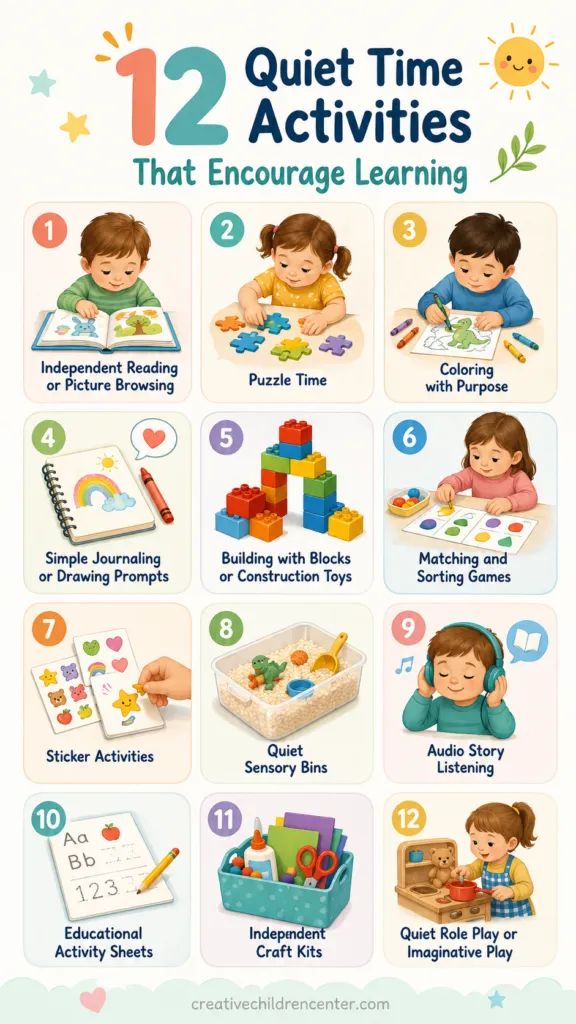
12 Quiet Time Activities That Encourage Learning
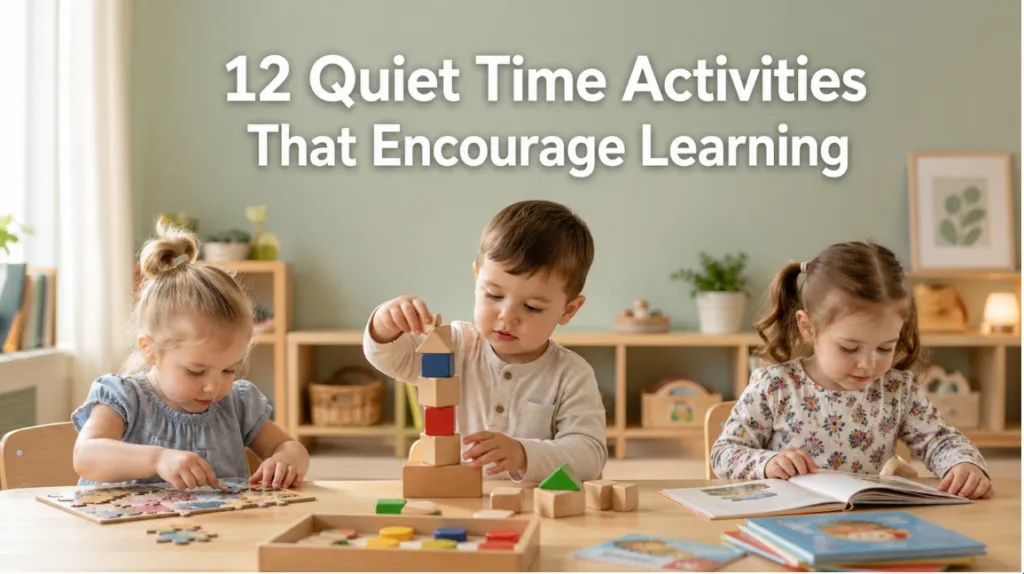
These quiet time activities are used and refined in real childcare settings. Each one supports development while keeping children calmly engaged.
1. Independent Reading or Picture Browsing
For preschoolers and school-age children, books are the backbone of quiet time.
For younger children, this might look like flipping through picture books and telling their own version of the story. Older children can read independently or revisit favorite chapters.
Why it works:
- Builds language and comprehension
- Encourages imagination
- Strengthens focus
Tip: Rotate books weekly to keep interest high without overwhelming choices.
2. Puzzle Time
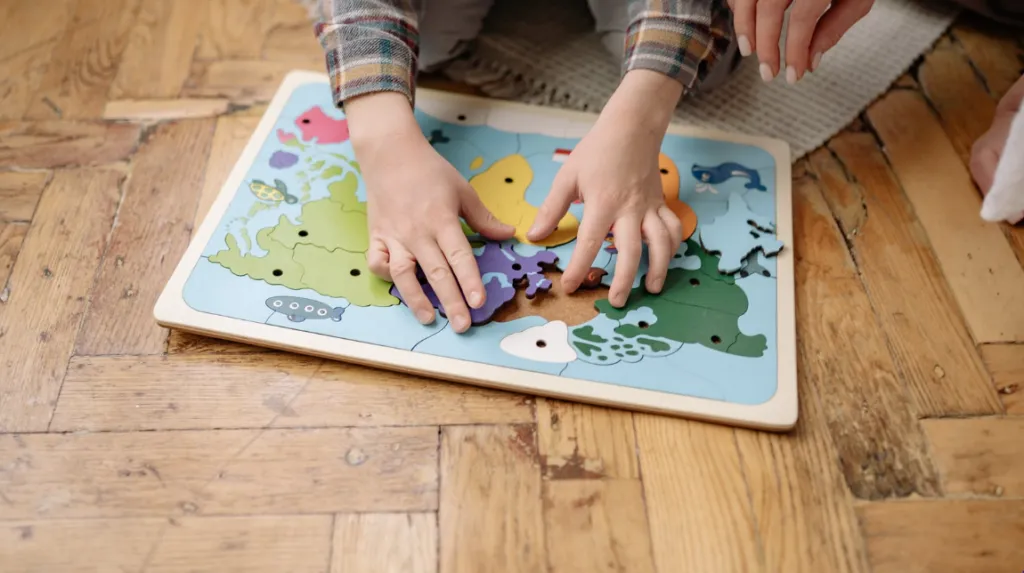
As part of quiet time activities, puzzles offer a structured, quiet challenge that naturally holds attention while supporting problem-solving skills across different ages.
- Toddlers: large knob puzzles
- Preschoolers: simple jigsaw puzzles
- School-age: more complex sets
Learning benefits:
- Problem-solving
- Spatial awareness
- Persistence
Some children will finish quickly and ask for more—others will take their time. Both are valuable.
3. Coloring with Purpose
Coloring is often dismissed as basic, but it can be surprisingly powerful when done intentionally.
Provide:
- Themed coloring pages (animals, seasons, letters)
- Crayons, colored pencils, or markers
Encourage children to:
- Stay within lines (fine motor control)
- Choose colors thoughtfully
Best practice: Avoid over-directing. Let children make creative choices.
4. Simple Journaling or Drawing Prompts
For preschoolers and older children, a quiet journal can become a meaningful habit.
Examples:
- “Draw your favorite part of the day”
- “What would you build if you had a giant box?”
Younger children can draw; older ones can write a few sentences.
Why it matters:
- Encourages self-expression
- Builds early writing skills
- Supports emotional processing
5. Building with Blocks or Construction Toys
This is one of the most versatile quiet time activities.
Children can:
- Build structures
- Recreate familiar places
- Experiment with balance and design
What it develops:
- Engineering thinking
- Creativity
- Patience
Here’s where nuance comes in: some builds can get noisy or collaborative. Setting a “quiet building” expectation helps maintain the tone.
6. Matching and Sorting Games
These are especially effective for toddlers and preschoolers.
Examples:
- Matching cards
- Sorting by color, shape, or size
- Simple memory games
Learning outcomes:
- Early math skills
- Categorization
- Attention to detail
Keep materials simple and uncluttered.
7. Sticker Activities
Sticker activities are one of those quiet time activities that naturally draw children in, keeping them focused while quietly supporting creativity and early learning.
Use:
- Sticker books
- Create-your-own scenes
- Pattern-building activities
Benefits:
- Fine motor development
- Creativity
- Focus
A small detail that makes a big difference: limit the number of stickers available at one time to avoid overwhelm.
8. Quiet Sensory Bins
Sensory play doesn’t have to be loud or messy.
Use bins with:
- Rice, beans, or sand
- Small scoops or cups
- Hidden objects to find
What children learn:
- Exploration
- Calm engagement
- Tactile awareness
That said, this isn’t ideal for every home setup. It depends on space, supervision, and tolerance for cleanup.
9. Audio Story Listening
For children who struggle to sit with books, audio stories can be a game changer.
Options include:
- Recorded storybooks
- Child-friendly podcasts
- Music with storytelling elements
Why it works:
- Builds listening skills
- Encourages imagination
- Supports language development
Pair it with a quiet activity like drawing for best results.
10. Educational Activity Sheets
Educational activity sheets can be a helpful addition to quiet time activities when used thoughtfully—not excessively.
Examples:
- Tracing letters or numbers
- Simple math puzzles
- Word searches for older children
Key insight: These should feel like a choice, not a requirement. Overuse can lead to resistance.
11. Independent Craft Kits
Pre-prepared craft kits reduce decision fatigue and keep children focused.
Ideas:
- Paper folding
- Bead threading
- Simple cut-and-paste projects
Learning benefits:
- Following instructions
- Fine motor skills
- Creativity within structure
Prepare materials in advance to avoid interruptions.
12. Quiet Role Play or Imaginative Play
This fits well within quiet time activities, even though it might seem counterintuitive at first, because it encourages calm, focused engagement.
Examples:
- Playing with dolls or figures
- Pretend kitchen setups
- Creating small “scenes”
What it supports:
- Social understanding
- Storytelling
- Emotional expression
The key is setting boundaries—quiet voices, contained space.
How to Structure Quiet Time at Home
Even the best activities won’t work without a solid structure.
Start with a clear routine
Choose a consistent time each day—after lunch works well for many families.
Set expectations upfront
Explain:
- What quiet time looks like
- How long it lasts
- What children can choose from
Use a timer
This helps children understand that quiet time has a clear beginning and end.
Offer limited choices
Too many options can lead to indecision. Three to five choices is usually enough.
Myth: Quiet Time Means No Interaction at All
Many parents assume quiet time means complete independence from the start.
That’s not realistic.
Children—especially younger ones—need support to build this skill. A caregiver may need to:
- Sit nearby initially
- Help them choose an activity
- Gently redirect when attention drifts
The real goal is gradual independence, not immediate perfection. Pushing too hard too quickly often backfires, leading to frustration for both the child and the adult.
When Quiet Time Doesn’t Go as Planned
Even with the best setup, some days won’t work.
Children may:
- Feel restless
- Resist the routine
- Switch activities frequently
This is normal.
A childcare center approach would be to:
- Stay consistent
- Adjust expectations based on age and energy levels
- Reflect on whether the activity choices are still engaging
Sometimes, the issue isn’t the child—it’s that the activity no longer matches their developmental stage.
Choosing the Right Activities for Your Child
There’s no one-size-fits-all solution.
A few guiding principles:
- Follow interests: A child who loves animals may engage longer with animal-themed materials
- Match energy levels: After a busy morning, calmer activities work better
- Rotate regularly: Familiar doesn’t have to mean boring, but variety helps
It depends on the child, the environment, and even the day.
Build Focus, Not Just Silence—Here’s What Actually Works
Quiet time, when done well, becomes more than a daily break—it turns into a powerful learning window. The most effective families don’t aim for perfection or silence. Instead, they prioritize consistency, thoughtful activity choices, and gradual independence. Over time, children learn how to engage deeply, manage their attention, and find calm without constant stimulation. That’s a skill that extends far beyond childhood.
For families who want more structured support, guidance, and developmentally appropriate routines, Creative Children Center offers programs designed to build these exact habits in a nurturing, real-world environment. Whether at home or in a center, the goal remains the same: helping children grow into focused, curious, and capable learners—one quiet moment at a time.