
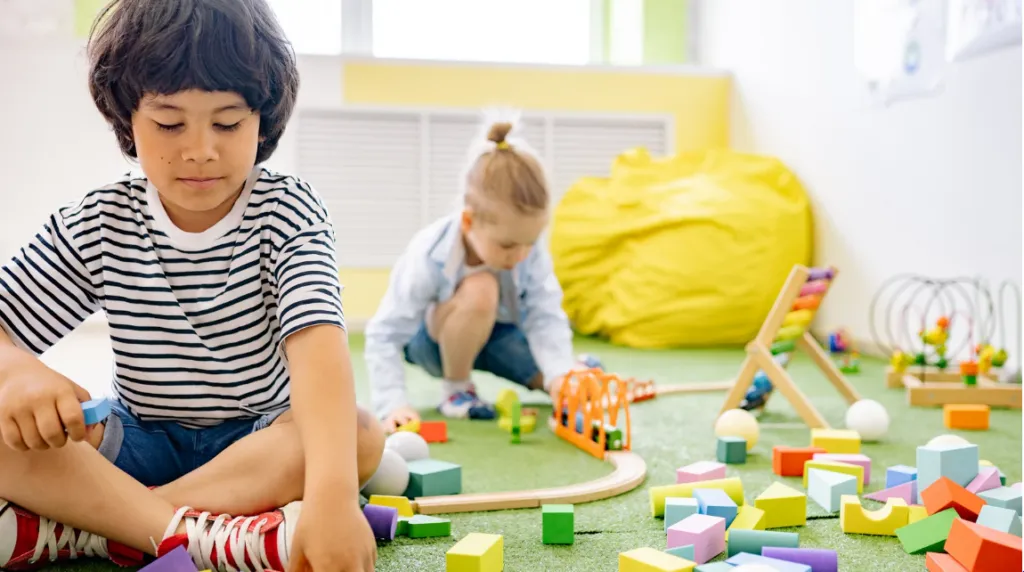
A parent sits at the table trying to read a short picture book, but halfway through, the child slides off the chair, grabs a toy, then wanders toward the window. It’s a familiar moment. Many families wonder whether this is just “being a kid” or something to worry about—especially as expectations around early learning and school readiness continue to rise.
Understanding attention span in preschoolers matters more than ever. With increased screen exposure, structured learning pressures, and comparisons to peers, it’s easy to misjudge what’s developmentally appropriate. This article clarifies what’s normal, what’s not, and how families can realistically support attention skills across toddlers, preschoolers, and even school-age children.
By the end, readers will know how attention develops, what behaviors are typical, where concerns may be valid, and what practical steps actually help—based on real childcare experience, not theory alone.
What “Attention Span” Really Means in Young Children
Attention span isn’t just about how long a child can sit still. That’s where many misunderstand things.
In early childhood, attention includes:
- The ability to focus on a task
- The ability to return to a task after distraction
- The flexibility to shift attention when needed
- The emotional regulation that supports staying engaged
A preschooler who builds blocks for five minutes, gets distracted, then returns to finish is demonstrating healthy attention—even if they didn’t sit continuously.
This is usually overlooked, but it matters: attention is not linear. It’s dynamic, especially under age six.
What’s Normal by Age Group
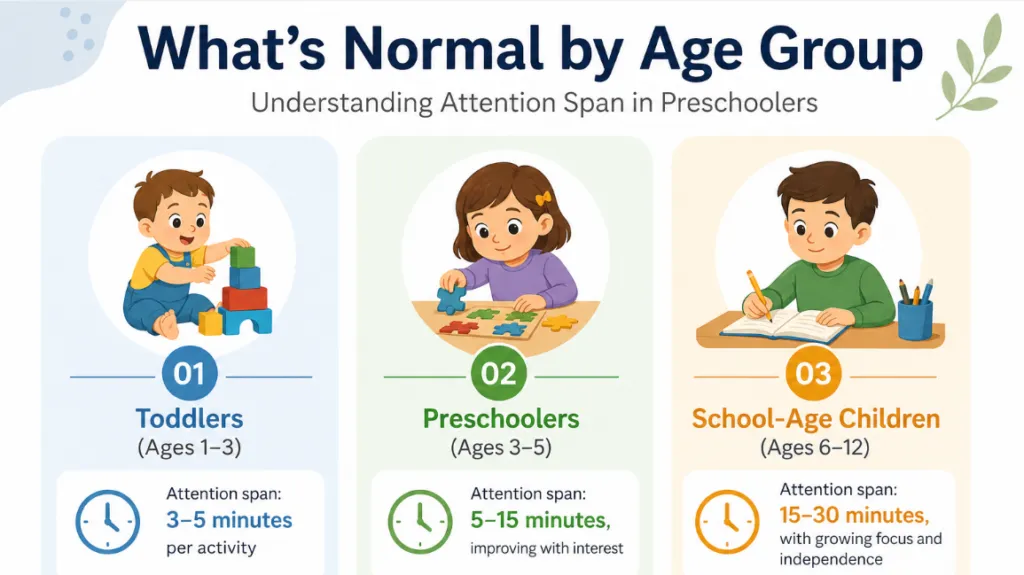
There’s no fixed number that defines a “good” attention span, but experienced childcare providers often use general ranges as a guide.
Toddlers (Ages 1–3)
At this stage, attention is brief and highly dependent on interest.
Typical patterns:
- 2 to 5 minutes of focus on a single activity
- Frequent switching between activities
- Strong preference for sensory and movement-based play
Expecting sustained attention here often leads to frustration—for both child and adult.
Preschoolers (Ages 3–5)
This is where attention begins to stretch—but still in uneven ways.
Typical patterns:
- 5 to 15 minutes of focus on engaging tasks
- Longer attention for preferred activities (e.g., puzzles, pretend play)
- Shorter attention for adult-directed tasks
A key nuance: a child may focus for 20 minutes on building something but struggle to sit for a 5-minute group activity. That doesn’t indicate a problem—it reflects motivation and developmental readiness.
School-Age Children (Ages 6–12)
Attention becomes more structured, especially with school demands.
Typical patterns:
- 15 to 30+ minutes of sustained focus
- Ability to follow multi-step instructions
- Increasing ability to delay gratification
However, even at this stage, attention fluctuates based on sleep, environment, and emotional state.
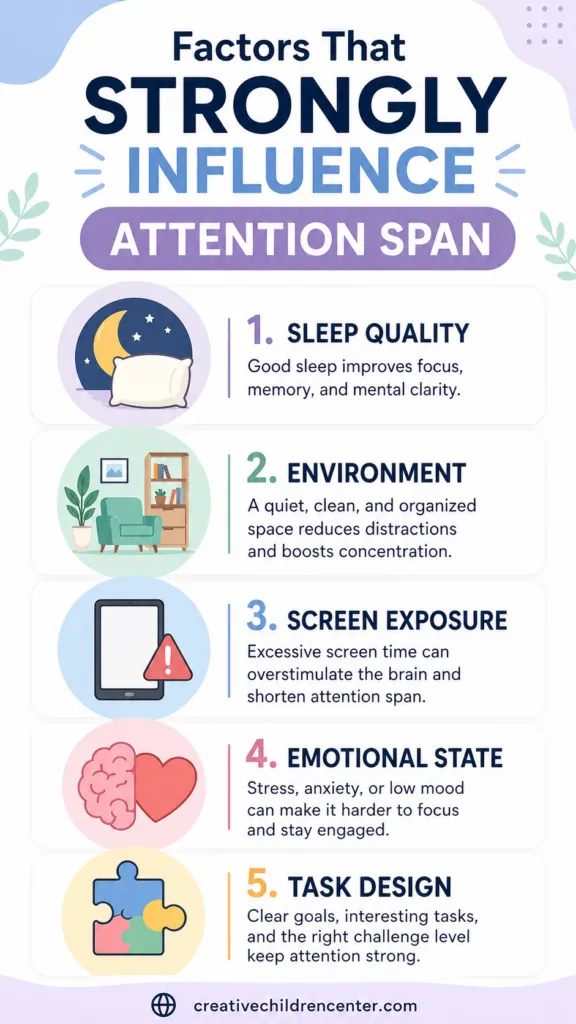
Factors That Strongly Influence Attention Span
Attention doesn’t develop in isolation. It’s shaped by multiple overlapping factors.
1. Sleep Quality
Children who are overtired struggle significantly with focus. This is one of the most common, yet underestimated, causes of short attention spans.
2. Environment
Busy, noisy, or overstimulating environments reduce attention—especially for younger children.
A cluttered play area often leads to scattered play behavior.
3. Screen Exposure
Fast-paced digital content can condition children to expect constant stimulation.
This doesn’t mean all screen time is harmful, but excessive or poorly structured use can shorten attention for slower-paced activities like reading or building.
4. Emotional State
Stress, anxiety, or transitions (new school, new sibling) can temporarily reduce attention span.
Here’s where things often go wrong: adults interpret this as a behavioral issue rather than an emotional response.
5. Task Design
If an activity is too easy, too hard, or not meaningful, attention drops quickly.
Engagement—not just discipline—drives focus.
Common Mistakes Parents Make
Even well-intentioned families sometimes work against attention development without realizing it.
Mistake 1: Expecting “Sit Still” = Focus
A child who wiggles or moves may still be engaged. For many children, movement actually supports attention.
Mistake 2: Over-Scheduling Activities
Constant transitions between classes, lessons, and structured play can reduce deep focus time.
Children need unstructured play to build sustained attention naturally.
Mistake 3: Interrupting Concentration
Adults often step in too quickly—correcting, guiding, or praising.
This breaks the child’s attention cycle. In many cases, less interference leads to longer focus.
Mistake 4: Comparing to Other Children
Attention varies widely. One child sitting quietly doesn’t mean another is “behind.”
Development is not uniform, especially under age six.
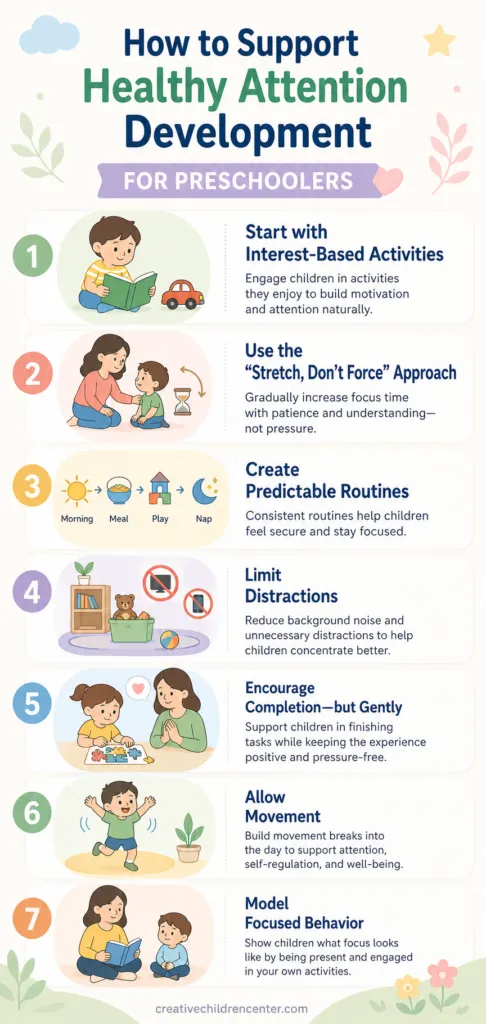
How to Support Healthy Attention Development
Improving attention isn’t about forcing longer focus—it’s about creating the right conditions.
1. Start with Interest-Based Activities
Children naturally focus longer on what they enjoy.
Examples:
- Building blocks
- Drawing or coloring
- Pretend play scenarios
- Simple puzzles
Once attention strengthens here, it gradually transfers to other tasks.
2. Use the “Stretch, Don’t Force” Approach
If a child focuses for 5 minutes, aim for 6—not 15.
Small, consistent increases build real progress.
3. Create Predictable Routines
Children focus better when they know what to expect.
A simple daily rhythm (play, snack, quiet time) reduces cognitive load and improves engagement.
4. Limit Distractions
- Reduce background noise (TV, loud devices)
- Offer fewer toys at a time
- Rotate materials instead of overwhelming with choices
A simpler environment often leads to deeper play.
5. Encourage Completion—but Gently
Instead of forcing, use prompts like:
- “Do you want to finish this part first?”
- “Let’s do one more piece together.”
This builds persistence without creating resistance.
6. Allow Movement
For many children, sitting still is not necessary for attention.
Standing, shifting, or even pacing can support focus—especially in early years.
7. Model Focused Behavior
Children observe adult behavior closely.
If adults frequently multitask, check phones, or shift attention quickly, children mirror that pattern.
When Attention Might Be a Concern
Not every short attention span is normal, but context matters.
Potential red flags include:
- Inability to focus even on preferred activities
- Extremely high impulsivity beyond age expectations
- Difficulty following simple instructions consistently
- Persistent challenges across multiple settings (home, school, social)
Even then, it’s rarely helpful to jump to conclusions.
“It depends” is important here. Some children simply develop these skills later, while others may benefit from additional support.
A professional evaluation may be appropriate if concerns are consistent and impacting daily functioning.
Myths About Attention Span in Preschoolers
Myth 1: “A good preschooler should sit still for long periods”
This expectation is unrealistic. Movement is part of how young children learn and regulate themselves.
Forcing stillness too early can actually reduce engagement.
Myth 2: “Short attention span means behavioral problems”
Often, it reflects developmental stage, environment, or task mismatch—not a behavioral issue.
Myth 3: “Educational apps improve attention”
Some apps can teach skills, but they don’t necessarily build sustained attention.
In fact, fast-paced content may do the opposite if overused.
Myth 4: “More structured learning builds better focus”
Too much structure too early can backfire.
Children develop attention best through a balance of guided and independent play.
Practical Daily Strategies That Work
These are approaches experienced childcare providers consistently see results from:
- Rotate toys weekly to maintain novelty without overstimulation
- Use timers for transitions (e.g., “5 more minutes of play”)
- Break tasks into smaller steps
- Offer choices to increase engagement (“Do you want to draw or build?”)
- Schedule quiet play time daily
- Prioritize outdoor play—this significantly improves focus afterward
One example: a preschooler who struggles to sit for a story may engage better after 20 minutes of outdoor activity. The change isn’t behavioral—it’s physiological.

Attention Across Different Personalities
Not all children focus in the same way.
Some are naturally:
- Deeply focused but slower to transition
- Highly curious but easily distracted
- Socially driven rather than task-driven
None of these are inherently problems.
The goal isn’t to standardize behavior—it’s to support each child’s ability to engage, persist, and adapt over time.
What Families Should Focus on Most
If there’s one priority, it’s this: build attention through meaningful, enjoyable experiences—not pressure.
Children don’t develop focus by being told to “pay attention.” They develop it by being engaged, supported, and given space to explore.
Consistency matters more than intensity.
What Actually Matters More Than “Longer Attention”
Many families chase longer attention spans, but experienced educators look at something slightly different:
- Can the child return to a task after distraction?
- Can they stay engaged when interested?
- Can they gradually increase focus over time?
These indicators are far more meaningful than how long a child sits still in one moment.

Read This Before You Worry Too Much
Most preschool attention concerns turn out to be normal developmental variation. Short attention spans, frequent movement, and shifting interests are part of healthy growth—not signs of failure.
What makes the biggest difference is environment, expectations, and how adults respond. When children are given the right balance of structure, freedom, and support, attention develops naturally over time.
For families looking for a more guided approach, Creative Children Center provides structured yet flexible programs designed to match each child’s developmental stage. Their approach combines play-based learning, routine-building, and individualized attention support—helping children build focus in ways that are realistic, sustainable, and aligned with how they actually grow.