
Helping young children learn how to think, decide, and solve small challenges is one of the most powerful ways to support early development. During the preschool years, the brain is growing rapidly, and everyday experiences shape how children understand the world around them. This is why playful learning is not just “fun time”—it is foundational learning in disguise.
One of the most effective ways to support this growth is through problem solving activities for preschoolers. These activities encourage children to think independently, test ideas, make decisions, and learn from outcomes in a safe and engaging way. Instead of simply giving answers, we guide them to explore possibilities, which builds confidence and curiosity that lasts far beyond early childhood.
Why Problem Solving Skills Matter in Early Childhood
Problem-solving is not just an academic skill—it is a life skill. Preschoolers use it every day without even realizing it, whether they are figuring out how to stack blocks or deciding how to share toys.
When children develop strong problem-solving abilities early, they gain:
- Better decision-making skills
- Stronger independence
- Improved emotional regulation
- Higher confidence in unfamiliar situations
- Greater persistence when facing challenges
These skills also connect closely to early academic readiness. A child who can think through problems is more prepared to understand math patterns, reading comprehension, and classroom instructions.
For a deeper understanding of how these skills fit into early growth, many educators refer to the Child Development Milestones Guide, which outlines key developmental stages and expected abilities at different ages.
The Science Behind How Preschoolers Learn to Solve Problems
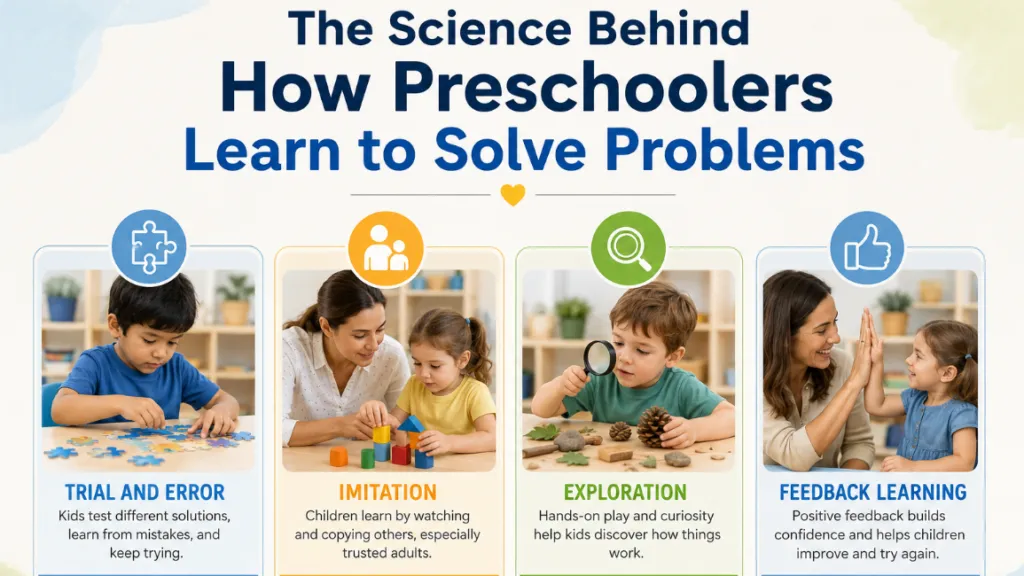
At the preschool stage, children are not learning through memorization—they are learning through experience. Their brains are forming connections based on repetition, exploration, and emotional engagement.
Here’s how problem-solving develops naturally:
- Trial and error: Children test ideas and observe results
- Imitation: They copy behaviors from adults and peers
- Exploration: They experiment with objects and environments
- Feedback learning: They adjust based on success or failure
This is why hands-on learning is so effective. When children physically interact with materials, their brains process information more deeply compared to passive instruction.
The best problem solving activities for preschoolers take advantage of this natural learning style by encouraging exploration instead of instruction-heavy teaching.
Simple Problem-Solving Activities That Work at Home or School
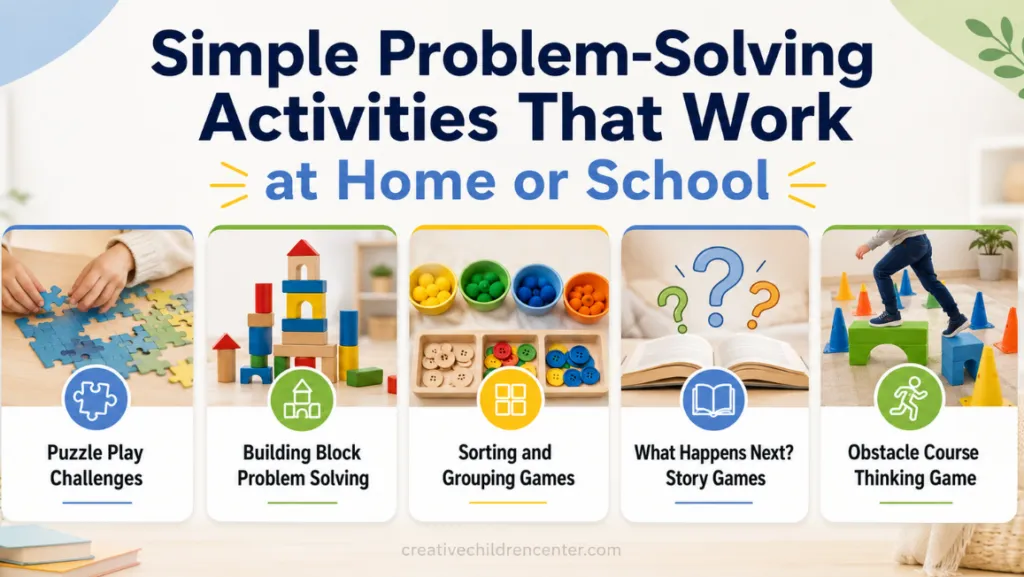
You don’t need expensive tools or structured lessons to introduce problem solving activities for preschoolers. Everyday moments are powerful learning opportunities. Here are practical and engaging ideas:
1. Puzzle Play Challenges
Puzzles teach children how to recognize patterns and think logically.
Try this:
- Start with simple 4–6 piece puzzles
- Ask guiding questions like “Where does this piece fit?”
- Encourage persistence instead of giving answers
2. Building Block Problem Solving
Blocks are excellent for spatial reasoning.
Ideas include:
- “Build a bridge that doesn’t fall” challenge
- “Can you make a taller tower using fewer blocks?”
- “What shape makes your structure stronger?”
3. Sorting and Grouping Games
Sorting helps children understand classification and logic.
You can use:
- Toys by color or size
- Household items (buttons, spoons, socks)
- Nature items like leaves or stones
4. “What Happens Next?” Story Games
Reading time becomes problem-solving time when you pause and ask questions.
Try:
- “What do you think will happen next?”
- “Why did the character do that?”
- “What would you do differently?”
5. Obstacle Course Thinking Game
This combines physical movement with decision-making.
Set up:
- Cushions to climb over
- Chairs to crawl under
- A path with simple rules
Ask:
- “What is the fastest way to get through this?”
- “Can you find another way?”
Creative Problem Solving Activities for Preschoolers Using Everyday Objects
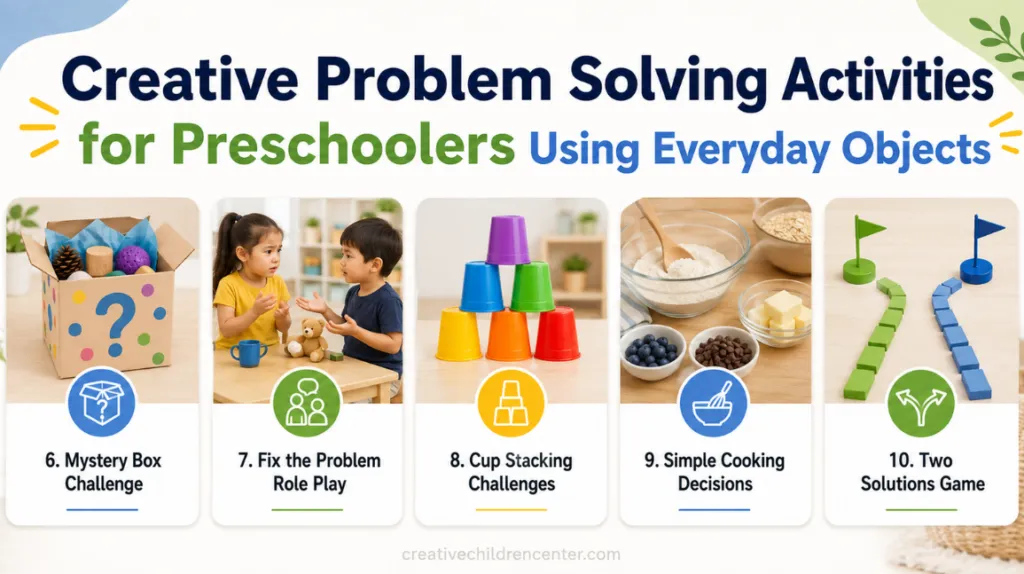
Some of the best problem solving activities for preschoolers use simple household items. These activities encourage imagination and flexible thinking.
6. Mystery Box Challenge
Place random objects in a box and let children guess and explain their thinking.
- Encourage describing textures and shapes
- Ask why they made certain guesses
- Reveal items slowly for excitement
7. “Fix the Problem” Role Play
Create simple pretend scenarios:
- A broken toy that needs fixing
- A stuffed animal stuck somewhere
- A missing item in a story setup
Ask: “How can we solve this?”
8. Cup Stacking Challenges
Using plastic cups, give small tasks like:
- Build the tallest tower
- Create a stable shape that won’t fall
- Rebuild after it collapses
This teaches resilience and experimentation.
9. Simple Cooking Decisions
Involving children in snack preparation builds decision-making.
Examples:
- Choosing toppings for fruit
- Deciding how to arrange food on a plate
- Measuring ingredients with guidance
10. “Two Solutions” Game
Present a small problem and ask for two possible solutions.
Example:
- “Your toy broke. What can you do?”
- “It is raining and you want to play outside. What now?”
This builds flexible thinking instead of single-answer dependence.
How Problem Solving Builds Emotional Strength
Problem-solving is not only about thinking—it is also about managing emotions. When children face challenges, they often feel frustration or disappointment.
Through guided activities, they learn:
- How to stay calm when something doesn’t work
- How to try again without giving up
- How to ask for help appropriately
- How to celebrate small successes
This emotional resilience is just as important as intellectual development. Children who learn to manage frustration early are more likely to adapt well in school and social environments.
Age-Appropriate Expectations for Problem Solving Skills
Match specific problem solving activities for preschoolers directly to their unique development stage.
Ages 2–3:
- Simple choices (“red or blue?”)
- Basic sorting games
- Repeating patterns
Ages 3–4:
- Building simple structures
- Completing puzzles
- Answering “what if” questions
Ages 4–5:
- Multi-step challenges
- Independent thinking tasks
- Explaining reasoning (“why did you choose that?”)
Matching activities to developmental stages ensures children stay engaged without feeling overwhelmed.
Common Mistakes When Teaching Problem Solving
Even with the best intentions, some approaches can limit learning.
Avoid these common mistakes:
- Giving answers too quickly: Children learn more when they struggle a little
- Over-directing activities: Too much instruction reduces creativity
- Expecting perfect results: Mistakes are part of learning
- Doing the task for the child: This removes independence-building opportunities
- Using only structured worksheets: Real-world play is more effective at this age
The goal is to guide, not to solve for them.
How to Encourage Daily Problem Solving Naturally
The best learning happens in everyday routines. You don’t need separate “learning time” for problem-solving.
Try integrating it into daily life:
- Let children choose between outfit options
- Ask how they would clean up toys efficiently
- Involve them in simple planning (“What should we do first?”)
- Encourage them to fix small mistakes independently
- Turn small frustrations into thinking moments
These small interactions add up and build strong mental habits over time.
Why Play-Based Learning Is So Powerful
Play is not just entertainment—it is the primary way preschoolers understand the world. When children play, they are constantly experimenting with ideas, testing boundaries, and learning outcomes.
That is why problem solving activities for preschoolers are most effective when they feel like play rather than instruction.
Through play, children naturally develop:
- Creativity
- Logical thinking
- Social awareness
- Decision-making skills
Play removes pressure, making learning feel safe and enjoyable.
Building Lifelong Thinkers Through Everyday Moments
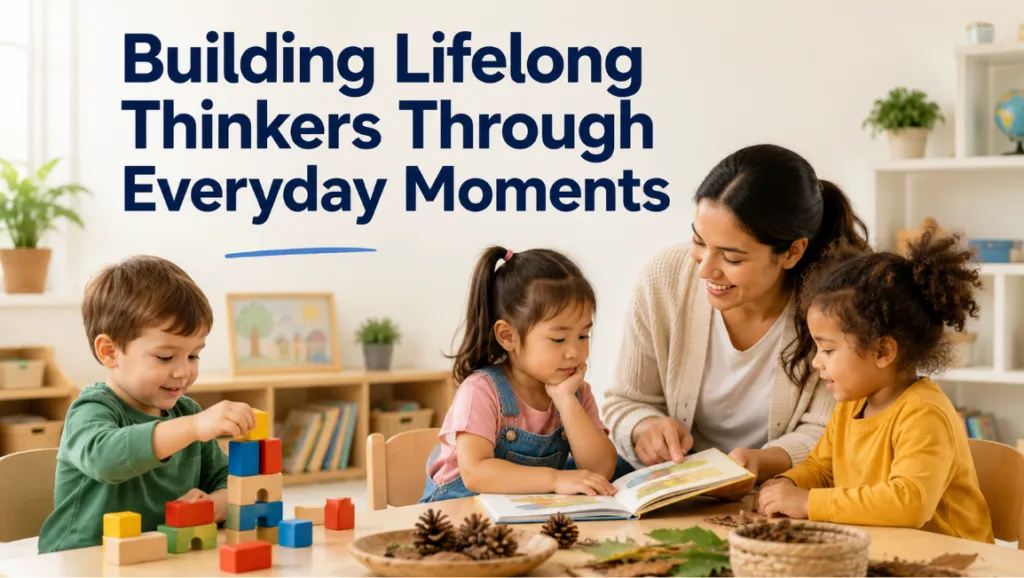
Problem-solving is not something children learn once—it is a skill built gradually through repeated experiences. Every puzzle completed, every block tower rebuilt, and every question answered adds another layer to their thinking ability.
When supported consistently, these early experiences shape how children approach challenges throughout life. They become more confident, more independent, and more willing to try new things even when they are unsure.
Building Bright Minds Through Everyday Discovery
Early childhood is a critical time for shaping how children think, explore, and respond to challenges. By intentionally using simple, engaging activities, caregivers can nurture strong thinking skills that support both academic and emotional growth.
When families understand the value of problem solving activities for preschoolers, they unlock opportunities to turn everyday moments into meaningful learning experiences that build smarter thinking every day.
For families looking to support early development through structured, play-based learning environments, Creative Children Center LLC offers programs designed to nurture curiosity, independence, and confidence. If you’re ready to take the next step in your child’s learning journey, Learn About Our Preschool Program and discover how guided play can help your child grow into a confident problem solver.